
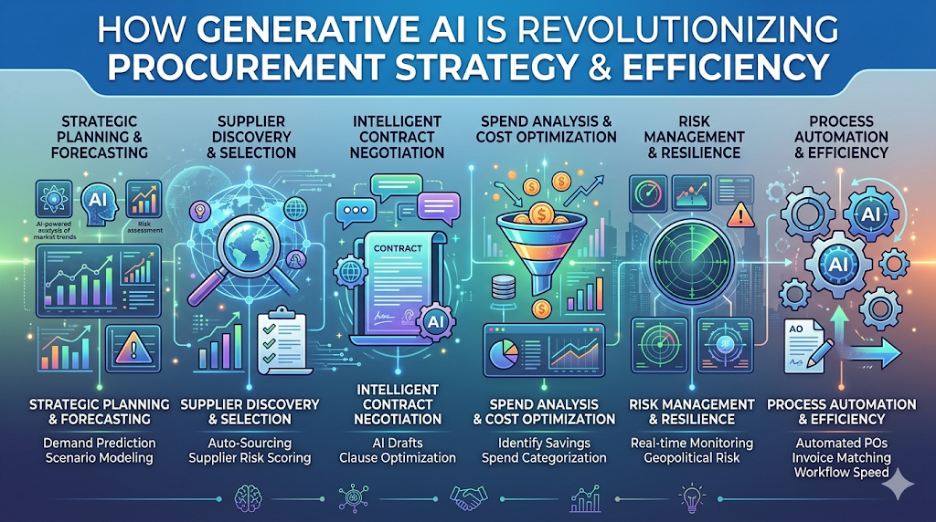
Procurement functions are under increasing pressure to deliver cost savings, manage supplier risk and support broader business objectives. As organizations navigate global supply complexities and economic uncertainty, traditional procurement methods often struggle to keep pace. Generative artificial intelligence is emerging as a transformative capability that enhances decision-making, automates processes and enables more strategic procurement operations.
By leveraging advanced data analysis and machine learning, generative AI allows procurement teams to move beyond transactional activities and focus on value creation. It empowers organizations to analyze vast amounts of data, generate insights and optimize sourcing strategies in real time. As a result, procurement is evolving into a more agile, data-driven function that plays a critical role in enterprise performance.
Overview of AI in procurement
Artificial intelligence in procurement refers to the use of advanced algorithms and machine learning models to automate and enhance procurement processes. These technologies enable organizations to analyze supplier data, predict market trends and optimize purchasing decisions.
Generative AI takes these capabilities further by generating new insights, recommendations and scenarios from existing data. It can generate contract drafts, suggest sourcing strategies and simulate negotiation outcomes, providing procurement professionals with powerful tools to improve efficiency and effectiveness.
Organizations are increasingly investing in AI integration to ensure seamless adoption of AI technologies across procurement functions, often leveraging AI consultants to guide strategy and implementation. This integration allows procurement systems to work more intelligently, delivering insights that support better decision-making.
AI in procurement is not limited to automation. It also enhances collaboration, improves transparency, and enables organizations to respond quickly to changing market conditions. By embedding AI into procurement processes, organizations can achieve greater agility and resilience.
Benefits of AI in procurement
AI-driven procurement delivers significant advantages, helping organizations improve performance and reduce costs.
1. Enhanced cost optimization
AI analyzes spending patterns, supplier pricing and market conditions to identify cost-saving opportunities. It can recommend alternative suppliers, optimize contract terms and highlight inefficiencies in procurement processes. This leads to more strategic sourcing decisions and improved cost management.
2. Improved supplier management
AI enables organizations to evaluate supplier performance using real-time data and predictive analytics. It can identify potential risks, monitor compliance and recommend actions to strengthen supplier relationships. This ensures a more reliable and resilient supplier network.
3. Increased process efficiency
Automation powered by AI reduces manual tasks such as purchase order processing, invoice matching and contract management. This streamlines workflows and minimizes errors. Procurement teams can focus on strategic initiatives rather than routine activities.
4. Better risk mitigation
AI helps organizations identify and mitigate risks by analyzing external factors such as geopolitical events, financial stability and supply disruptions. It can generate risk scenarios and suggest mitigation strategies. This proactive approach improves supply continuity and reduces exposure to disruptions.
5. Data-driven decision-making
AI provides actionable insights that support informed decision-making. It enables scenario analysis and forecasting, helping procurement leaders evaluate different strategies. This results in more accurate and confident decisions that drive better outcomes.
Use cases of AI in procurement
AI is transforming procurement across multiple areas, delivering measurable value in real-world applications.
1. Strategic sourcing optimization
AI analyzes supplier data, market trends and historical performance to recommend optimal sourcing strategies. It can identify the best suppliers based on cost, quality and reliability. This improves sourcing efficiency and ensures better procurement outcomes.
2. Contract management automation
AI automates contract creation, review and compliance monitoring. It can generate contract drafts, identify key clauses and flag potential risks. This reduces contract cycle times and improves compliance.
3. Spend analysis and visibility
AI provides comprehensive visibility into procurement spending by analyzing data across categories and suppliers. It identifies spending patterns and highlights opportunities for consolidation. This enables organizations to optimize procurement strategies and reduce costs.
4. Supplier risk assessment
AI evaluates supplier risk by analyzing financial data, geopolitical factors and market conditions. It can generate risk scores and recommend alternative sourcing options. This enhances supply chain resilience and reduces dependency on high-risk suppliers.
5. Procurement process automation
AI automates routine procurement tasks such as purchase requisitions, approvals and order processing. It improves accuracy and reduces processing time. Organizations can achieve greater efficiency and productivity across procurement operations.
Businesses exploring advanced capabilities can learn more about AI in procurement solutions to enhance their procurement strategies and drive innovation.
Why choose The Hackett Group® for implementing AI in procurement
Implementing AI in procurement requires a strategic approach that combines technology expertise with deep functional knowledge. The Hackett Group® is recognized for its research-driven insights and proven methodologies that help organizations achieve superior performance.
The firm’s approach focuses on aligning AI initiatives with business goals, ensuring that organizations realize measurable value from their investments.
1. Benchmark-driven insights
The Hackett Group® leverages extensive benchmarking data to identify best practices in procurement. This enables organizations to understand their performance relative to peers and identify opportunities for improvement. These insights help organizations adopt strategies that drive efficiency and effectiveness.
2. Comprehensive transformation support
From strategy development to execution, The Hackett Group® provides end-to-end support for procurement transformation. This includes process redesign, technology implementation and change management. This ensures the successful adoption of AI across procurement functions.
3. Advanced analytics and technology expertise
The Hackett Group® combines advanced analytics with deep procurement expertise to deliver innovative solutions. Its capabilities enable organizations to harness the full potential of AI technologies.
The Hackett AI XPLR™ platform supports this transformation by providing tools and insights that enhance decision-making and automation.
4. Focus on measurable outcomes
The Hackett Group® emphasizes delivering tangible business results, including cost savings, efficiency improvements and risk reduction. Its data-driven approach ensures that AI initiatives generate real value. This focus on outcomes helps organizations achieve sustainable procurement transformation.
Conclusion
Artificial intelligence is reshaping procurement by enabling smarter, faster and more strategic operations. From cost optimization to supplier management, its applications are broad and impactful. Organizations that embrace AI can improve efficiency, reduce risks and gain a competitive advantage in a rapidly evolving business environment.
As procurement continues to evolve, the adoption of AI will become increasingly critical. Organizations that invest in the right strategies, technologies and expertise will be better positioned to succeed. By leveraging proven methodologies and advanced capabilities, procurement leaders can transform their functions and drive long-term value.