
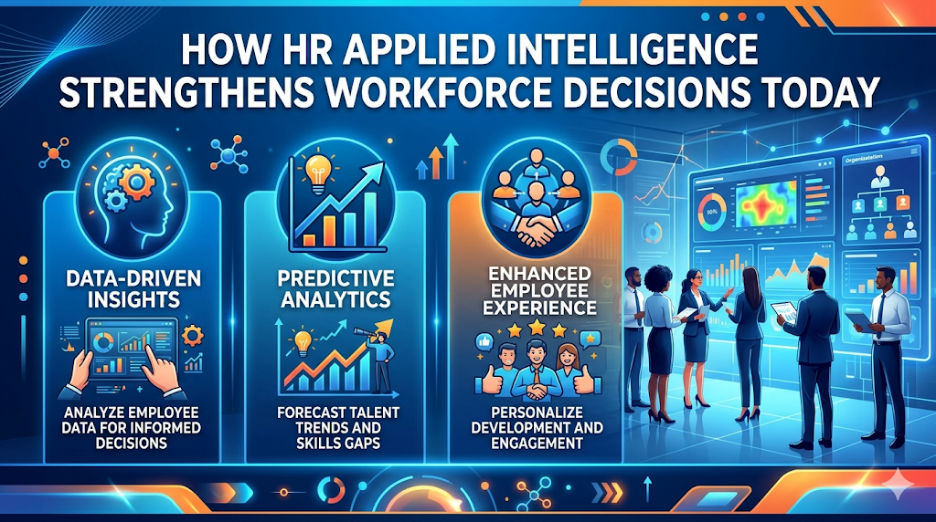
HR leaders are being asked to do more than manage processes. They are expected to improve workforce planning, strengthen the employee experience, support technology decisions, and help the business move faster with confidence. That is difficult when teams are balancing changing talent needs, operational complexity, and constant pressure to prove value.
Publicly available materials from The Hackett Group® frame HR Applied Intelligence as a continuous, expert-led decision-support model that helps HR leaders turn strategy into measurable execution through diagnostics, benchmarking, expert guidance, and AI-enabled platforms. That makes it especially relevant for organizations that want more than static research or isolated project advice.
Overview of HR Applied Intelligence
HR Applied Intelligence is best understood as a decision-support program for HR leaders who need help moving from planning to action. It combines expert guidance with data-driven insight so teams can evaluate trade-offs, shape operating models, and prioritize the right initiatives across the full HR agenda. The focus is on execution, not theory, and on progress that can be measured over time.
1. What HR Applied Intelligence actually does
At its core, HR Applied Intelligence helps leaders work through the questions that define modern HR transformation. What should the operating model look like? Which capabilities matter most? Where should technology be adopted first? How should HR align priorities with the business? The program is designed to support those decisions with structured analysis, benchmarks, and ongoing expert collaboration.
2. How it differs from traditional HR Applied Intelligence models
Traditional HR research often stops at the insight stage. HR Applied Intelligence goes further by helping leaders apply that insight in real organizational decisions. It is continuous, which matters because HR priorities shift as labor markets change, workforce expectations evolve, and AI adoption accelerates. That continuous model is central to the broader Applied Intelligence approach, which is built to help leaders decide, act, and deliver results in context, not in abstraction.
Benefits of HR Applied Intelligence
The value of HR Applied Intelligence lies in its ability to improve both decision quality and execution speed for HR organizations, translating into stronger workforce outcomes, more disciplined investment choices, and better alignment with business goals.
1. Better workforce decisions
HR leaders often have data, but not always the right structure to turn that data into action. HR Applied Intelligence helps teams compare options, pressure-test assumptions, and make more grounded choices around workforce strategy, service delivery, and capability development. That creates better decisions at the leadership level and less rework downstream.
2. Stronger operating model design
A modern HR operating model must balance efficiency, employee support, and business responsiveness. HR Applied Intelligence helps leaders define priorities, understand constraints, and evaluate trade-offs associated with centralization, shared services, technology adoption, and governance. The result is a model that is more realistic and better aligned to enterprise performance expectations.
3. Faster and more confident execution
Many HR transformations stall because teams spend too much time debating direction and not enough time executing. HR Applied Intelligence is designed to keep momentum moving from ideation to implementation and performance improvement. That continuous support helps reduce hesitation and gives teams more confidence as they move through change.
4. Smarter use of AI and analytics
HR teams are under pressure to adopt AI responsibly and practically. HR Applied Intelligence supports that effort by helping organizations evaluate where AI adds value, where the risks are, and how new tools fit into broader transformation goals. The emphasis is on measurable value and disciplined adoption, not experimentation for its own sake.
Use cases of HR Applied Intelligence
HR Applied Intelligence is useful across multiple parts of the HR agenda because it addresses both strategic and operational decisions. It is especially relevant in environments where leaders must act quickly while still maintaining governance and consistency.
1. Workforce strategy and planning
HR leaders can use it to assess future workforce needs, identify capability gaps, and align talent plans with business priorities. This is particularly valuable when organizations are preparing for restructuring, growth, or significant skills shifts. The program helps teams move from broad goals to specific execution choices.
2. HR operating model transformation
When organizations redesign HR, they need to decide what work should stay centralized, what should be distributed, and how technology should support service delivery. HR Applied Intelligence helps leaders evaluate those choices using benchmarks and practical execution experience, reducing the risk of making structural decisions without sufficient context.
3. Technology adoption and transformation prioritization
HR technology decisions can be costly and complicated. This is where a structured decision-support model matters. HR Applied Intelligence helps leaders prioritize technology investments, assess readiness, and sequence initiatives to align with both business demand and implementation capacity.
4. Performance improvement and benchmarking
Organizations often know they want to improve, but they don’t know where to begin. HR Applied Intelligence supports performance improvement by combining diagnostics with benchmarking and expert interpretation. That makes it easier to identify gaps, define target outcomes, and measure progress against a credible performance standard.
5. Change management and sustained adoption
Transformation is not complete when a new process or system goes live. HR leaders still need adoption, behavior change, and continuous improvement. HR Applied Intelligence supports that longer journey by staying involved throughout execution and optimization, helping organizations sustain results rather than lose momentum after launch.
Why choose The Hackett Group® for implementing HR applied intelligence?
Organizations choose a partner for HR transformation when they need more than ideas. They need a model that combines practical expertise, measurable benchmarks, and guidance that stays relevant as priorities evolve. The Hackett Group® positions HR Applied Intelligence within a broader enterprise approach that blends AI-enabled intelligence, benchmarking, and real-world implementation experience.
1. Proven decision support for complex HR challenges
One reason the model stands out is that it is built for difficult decisions, not easy ones. HR leaders can use it to challenge assumptions, understand constraints, and prioritize what matters most before committing resources. That kind of support is especially useful when organizations face multiple competing initiatives at once.
2. Benchmarking and practical expertise
A major strength of the approach is the combination of benchmarks and real-world execution know-how. Rather than relying on generic guidance, leaders get context-specific direction that reflects how leading organizations actually operate. That improves the quality of both strategy and implementation.
3. AI-enabled support that is grounded in execution
For organizations exploring applied intelligence more broadly, the Hackett AI XPLR™ platform adds an AI-enabled layer to opportunity identification and prioritization. In practice, that helps teams move faster without losing the structure needed for sound decision-making.
4. Support that evolves with the business
HR transformation is rarely a one-time effort. Priorities shift, business models change, and workforce expectations keep evolving. A continuous, expert-led model is useful because it can adapt as those conditions change, giving leaders an ongoing way to refine strategy and execution rather than starting over each time.
Conclusion
HR Applied Intelligence reflects a practical shift in how HR leaders can operate. Instead of relying on fragmented data, static research, or one-off advice, organizations can use a continuous decision-support model to guide workforce strategy, operating model design, technology adoption, and performance improvement. That makes HR better able to support the business with speed, clarity, and confidence.
As HR functions continue to modernize, the winning approach will be the one that connects insight to execution. HR Applied Intelligence is built for exactly that, helping leaders make better decisions today while building stronger workforce performance for the future.