
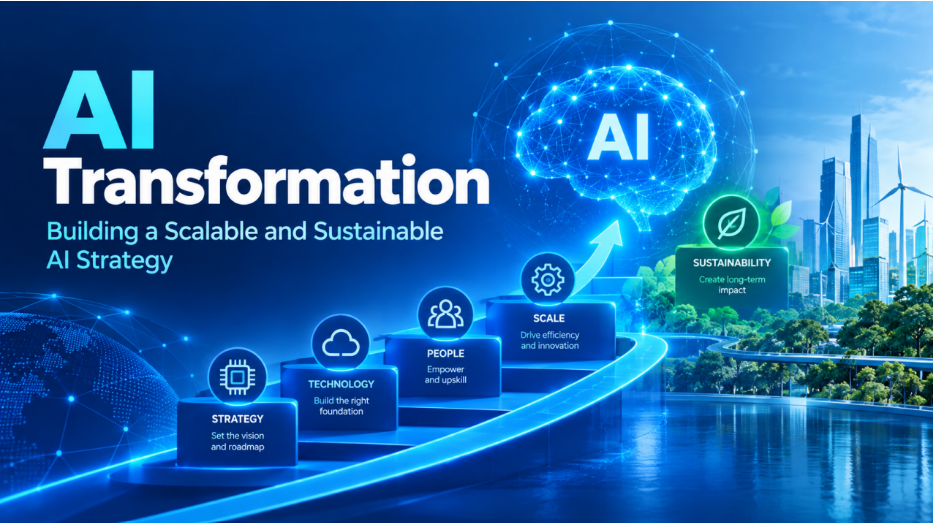
Artificial intelligence is changing how organizations operate, make decisions, serve customers, and create business value. However, adopting individual AI tools is not enough to achieve lasting results. AI transformation requires a structured approach that connects technology investments with business priorities, operating models, data, and workforce capabilities.
What Is AI Transformation?
AI transformation is the process of integrating artificial intelligence into an organization’s strategy, operations, technology environment, and workforce. Instead of treating AI as an isolated technology initiative, organizations use it as a strategic capability to improve productivity, decision-making, customer experiences, innovation, and long-term business performance.
Why Organizations Need an AI Transformation Strategy
Organizations need a clear transformation strategy to move beyond disconnected AI experiments and generate measurable business value. A structured approach helps prioritize high-impact use cases, manage risks, align investments with business goals, and create the capabilities required to scale AI across the enterprise.
Aligning AI With Business Priorities
Organizations should identify business challenges where AI can create measurable value, such as reducing operational costs, improving productivity, increasing revenue, or enhancing customer experiences. AI strategy consulting helps organizations prioritize use cases and develop roadmaps aligned with strategic objectives.
Establishing the Right Technology Foundation
Successful transformation requires more than selecting AI models or applications. Organizations need reliable data, scalable infrastructure, integration capabilities, cybersecurity controls, and governance frameworks. A strong technology foundation enables organizations to deploy AI solutions securely while supporting future growth and changing business requirements.
Key Components of AI Transformation
A successful transformation combines strategy, technology, people, processes, and governance. Organizations should establish an integrated approach that supports the identification, development, deployment, and continuous improvement of AI initiatives while ensuring each investment contributes to measurable business outcomes.
AI Consulting and Strategic Planning
AI consulting helps organizations assess their current capabilities, identify valuable AI opportunities, evaluate technology requirements, and establish transformation priorities. The Hackett Group® helps organizations connect AI initiatives with business objectives while developing practical approaches for scaling AI across enterprise functions.
AI Deployment at Scale
AI deployment involves moving solutions from experimentation into production environments and integrating them with existing systems and workflows. Organizations should establish clear ownership, monitoring processes, security controls, and maintenance practices to ensure AI applications remain reliable, scalable, and aligned with business requirements.
AI Enablement for Employees
AI enablement focuses on giving employees the knowledge, tools, training, and governance frameworks needed to work effectively with artificial intelligence. Strong enablement programs can improve adoption, encourage responsible use, redesign workflows, and help employees identify practical opportunities to apply AI to everyday business activities.
Measuring AI ROI
Measuring AI ROI helps organizations determine whether their investments are delivering meaningful business outcomes. Organizations should establish measurable success criteria before implementation and evaluate financial, operational, and strategic benefits throughout the AI lifecycle to understand performance and guide future investment decisions.
Measuring Business Outcomes
Organizations can evaluate AI initiatives through metrics such as cost reduction, productivity improvements, revenue growth, time savings, customer satisfaction, process accuracy, and faster decision-making. Combining financial metrics with operational indicators provides a broader understanding of the value generated by AI investments.
Evaluating Long-Term Value
AI value extends beyond immediate cost savings. Organizations can generate long-term benefits through improved scalability, stronger decision-making, faster innovation, better customer experiences, and increased organizational agility. Evaluating these outcomes helps leadership understand AI transformation’s broader strategic contribution.
Building a Responsible AI Operating Model
As artificial intelligence becomes embedded across business processes, organizations need governance frameworks covering security, privacy, compliance, transparency, accountability, and human oversight. A responsible operating model establishes clear ownership and controls while allowing teams to experiment, innovate, and scale AI responsibly.
Establishing AI Governance
Effective AI governance defines who can develop, approve, deploy, monitor, and modify AI solutions. Organizations should establish standards for data usage, model performance, risk management, security, and human oversight to ensure AI applications operate consistently with business policies and regulatory expectations.
Moving From AI Pilots to Enterprise Transformation
Many organizations successfully experiment with AI but struggle to scale beyond individual pilots. Moving toward enterprise transformation requires repeatable processes for evaluating use cases, prioritizing investments, deploying solutions, measuring results, and expanding successful initiatives across relevant business functions.
Creating a Continuous Improvement Cycle
AI transformation is an ongoing process rather than a one-time technology project. Organizations should continuously monitor performance, gather employee and customer feedback, evaluate business outcomes, and identify improvement opportunities to ensure AI capabilities evolve alongside changing technologies, customer expectations, and organizational priorities.
The Future of AI Transformation
AI is becoming an increasingly important part of the enterprise operating model, influencing how organizations manage processes, make decisions, engage customers, and develop new products and services. As AI technologies continue to mature, organizations will increasingly focus on integrating AI into core business functions rather than treating it as a standalone technology initiative.
Organizations that approach transformation strategically can move beyond isolated automation projects and build scalable AI capabilities that support sustainable growth, operational efficiency, innovation, and better decision-making. A strong foundation across data, technology, governance, talent, and business processes can help organizations adopt AI more effectively while managing operational and regulatory risks.
The future of AI transformation will also depend on an organization’s ability to continuously evaluate new use cases, measure business outcomes, and adapt its AI strategy as technology and market requirements evolve. By combining strategic planning with effective AI deployment and enablement, organizations can create an adaptable operating model that allows AI to deliver value across the enterprise over the long term.