
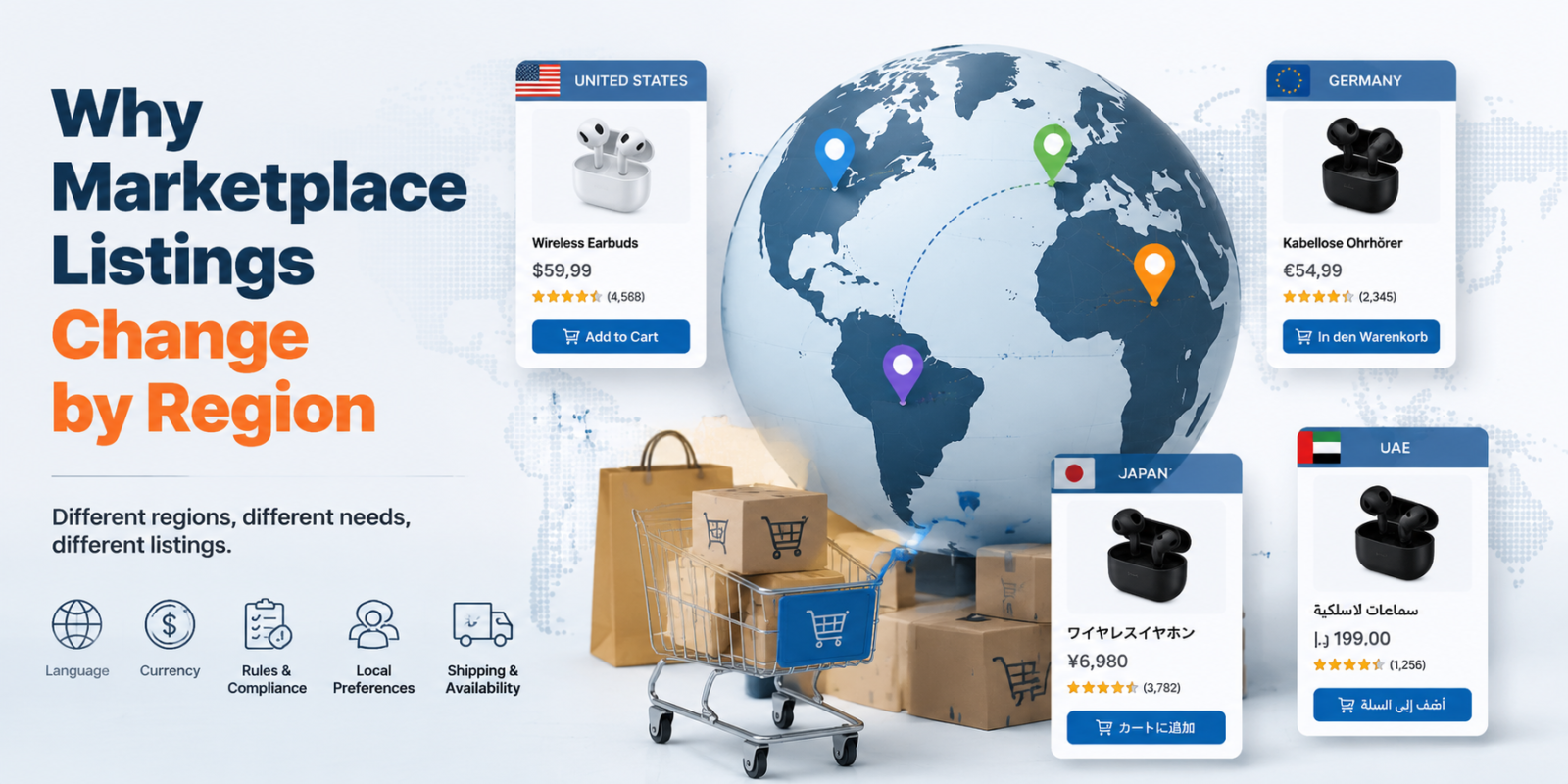
Many users assume that a product page looks the same for everyone. In reality, marketplaces heavily localize content based on user location.
Modern marketplaces adapt listings according to:
- country,
- language,
- currency,
- regional warehouses,
- shipping availability,
- local sellers,
- taxes,
- customer demand,
- browsing history,
- advertising campaigns.
For example, the same product on Amazon may:
- rank at the top in Germany,
- appear lower in France,
- have a different price in Canada,
- be sold by another merchant in Spain,
- or become unavailable in certain countries entirely.
For international ecommerce businesses, these differences are critical. Companies need to understand exactly how their products appear to customers in every target market.
What Companies Actually Monitor
Marketplace monitoring today goes far beyond simply checking prices. Businesses collect multiple categories of data at scale.
Search Rankings
One of the most important metrics is product visibility.
Companies monitor:
- keyword rankings,
- sponsored placements,
- category visibility,
- competitor positions,
- organic search movement.
A product dropping only a few positions in marketplace search results can significantly impact sales volume.
Price Monitoring
Price tracking is one of the biggest use cases for marketplace intelligence systems.
Businesses constantly monitor:
- competitor prices,
- discounts,
- shipping costs,
- regional pricing,
- flash sales,
- stock-related price changes.
This is especially important in industries such as:
- electronics,
- gaming,
- fashion,
- cosmetics,
- home appliances,
- automotive products.
Some brands update pricing strategies automatically after detecting competitor changes in specific countries.
Tracking Unauthorized Sellers
Large brands frequently struggle with unauthorized resellers and gray-market sellers.
These may include:
- unofficial distributors,
- counterfeit sellers,
- resellers violating pricing policies,
- regional arbitrage sellers.
Often these sellers appear only in certain countries, which is why businesses monitor marketplace listings region by region rather than globally.
Review Monitoring
Customer reviews also vary significantly between countries.
A product may have:
- excellent ratings in one market,
- poor feedback in another,
- complaints related to shipping,
- localization problems,
- packaging issues,
- or customer support concerns.
Companies analyze reviews to identify:
- product issues,
- regional demand patterns,
- localization problems,
- opportunities for improvement.
Why Simple Access Is Not Enough
The biggest technical challenge is that marketplaces aggressively limit automated data collection.
Once a system starts sending large numbers of requests, platforms may trigger:
- CAPTCHA challenges,
- temporary bans,
- IP restrictions,
- geo-blocking,
- rate limiting,
- suspicious activity detection.
In addition, marketplaces often display completely different results depending on the visitor’s geographic location. Accessing a marketplace from a single server cannot accurately simulate real users from dozens of countries.
This is why businesses rely heavily on proxy infrastructure.
Why Businesses Use Residential Proxies
When companies collect marketplace data internationally, they need to appear as regular users from specific countries.
Because of this, many businesses use residential proxy services such as ResidentialProxy.io to access marketplaces through real residential IP addresses.
This allows companies to:
- view localized search results,
- monitor regional prices,
- access country-specific listings,
- reduce blocking risks,
- collect data across multiple locations simultaneously.
For marketplace intelligence systems, geographic accuracy is often essential.
Why Datacenter Proxies Are Often Insufficient
Years ago, many scraping systems relied mostly on datacenter proxies. Today, large marketplaces have become much better at detecting automated traffic.
Modern anti-bot systems analyze:
- IP reputation,
- request patterns,
- browser fingerprints,
- behavioral signals,
- session consistency,
- regional activity anomalies.
As a result, traditional datacenter IPs are far more likely to face restrictions.
This is why businesses performing large-scale marketplace monitoring increasingly prefer residential proxy infrastructure for stable international access.
How Modern Marketplace Monitoring Systems Work
Large ecommerce companies typically build sophisticated internal monitoring systems.
These systems often include:
- crawlers,
- automation tools,
- task schedulers,
- databases,
- analytics dashboards,
- IP rotation systems,
- regional proxy pools.
A typical workflow may look like this:
- Connect to a marketplace from a target country.
- Perform keyword searches.
- Collect rankings and product data.
- Analyze pricing and stock availability.
- Store changes in databases.
- Generate reports and alerts.
Some companies run these checks daily, while others refresh marketplace data every few minutes.
Why Localized Data Matters for Marketing
Marketplace data is no longer useful only for operations teams. It also plays a major role in marketing and growth strategies.
Businesses use marketplace intelligence for:
- pricing optimization,
- competitor research,
- product launches,
- advertising strategy,
- inventory forecasting,
- market expansion analysis.
For example, if a product suddenly gains visibility in a specific country, a company may:
- increase advertising spend,
- allocate more inventory,
- localize product descriptions,
- launch regional campaigns.
Without localized marketplace tracking, businesses often miss these opportunities.
The Importance of Automation
Manual marketplace monitoring is nearly impossible at scale.
Even mid-sized ecommerce businesses may need to track:
- thousands of products,
- hundreds of competitors,
- dozens of countries,
- millions of pricing changes.
Automation has therefore become essential.
Modern systems automatically:
- collect marketplace data,
- detect ranking changes,
- monitor pricing,
- identify new competitors,
- send alerts,
- generate analytical reports.
This allows businesses to react much faster to market changes.
How Companies Reduce Blocking Risks
Since marketplaces actively fight aggressive automation, companies attempt to make traffic appear as natural as possible.
Typical approaches include:
- rotating IP addresses,
- browser automation,
- randomized request timing,
- session management,
- distributed traffic,
- residential proxy networks.
Without these measures, large-scale marketplace monitoring systems often become unreliable very quickly.
Why This Industry Continues to Grow
Global ecommerce competition continues to intensify every year.
Businesses increasingly depend on:
- regional pricing intelligence,
- competitor visibility data,
- seller monitoring,
- localized rankings,
- real-time marketplace analytics.
Because of this, the marketplace intelligence industry continues expanding rapidly.
This growth is especially visible among:
- ecommerce brands,
- analytics platforms,
- SaaS monitoring tools,
- pricing intelligence companies,
- agencies,
- international retailers.
In many industries, access to faster and more accurate marketplace data has become a major competitive advantage.
Conclusion
Modern marketplaces are no longer identical for all users. Product listings, rankings, prices, and sellers constantly change depending on the user’s country and region.
As a result, businesses increasingly invest in systems that monitor localized marketplace data across multiple countries simultaneously.
To collect this data reliably, many companies use residential proxy infrastructure that allows them to access marketplaces through region-specific IP addresses while reducing the risk of restrictions and blocking.
As international ecommerce competition grows, marketplace monitoring is becoming not just a useful tool, but a critical part of how modern online businesses operate.