
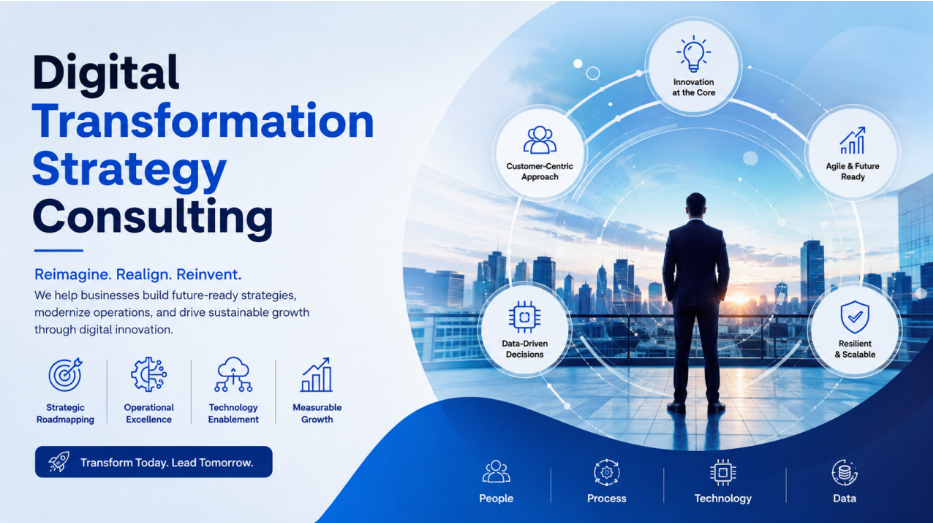
Organizations are accelerating digital investments to improve productivity, simplify operations and respond faster to changing business conditions. Yet technology implementation alone rarely delivers sustainable transformation. Fragmented processes, legacy systems, inconsistent data and unclear priorities can prevent organizations from realizing the expected value. Digital transformation strategy consulting provides a structured framework for connecting technology investments with enterprise objectives.
AI Consultants add another critical dimension by helping organizations determine where artificial intelligence can create the greatest business impact. Together, Digital transformation strategy consulting and AI Consultants can help organizations modernize processes, strengthen technology foundations and develop scalable AI capabilities that support long-term enterprise performance.
This article explores how Digital transformation strategy consulting and AI Consultants work together, their role in enterprise transformation, key business applications and priorities for successful implementation.
What is Digital transformation strategy consulting?
Digital transformation strategy consulting helps organizations define how technology, data, processes and operating models should evolve to support business strategy. It begins with assessing current performance and digital maturity before identifying the capabilities required for the future state.
A transformation strategy can address enterprise applications, cloud, data and analytics, artificial intelligence, automation, customer experience and workforce capabilities.
Rather than managing these areas as independent initiatives, Digital transformation strategy consulting creates an integrated roadmap that prioritizes investments based on business impact, implementation requirements and expected value.
What do AI Consultants do?
AI Consultants help organizations identify, prioritize and implement artificial intelligence opportunities aligned with business objectives. Their role can include AI readiness assessments, use case identification, data and technology evaluation, governance, implementation planning and value measurement.
They can assess processes across finance, HR, procurement, supply chain, IT and customer operations to determine where AI can improve productivity, decision-making or service performance.
AI Consultants also help organizations distinguish between use cases that are technically possible and those that can create meaningful economic or operational value.
Why digital transformation and AI strategy need to work together
Artificial intelligence depends on the broader digital environment surrounding it. AI cannot consistently deliver high-quality insights when enterprise data is fragmented, processes are poorly standardized or technology platforms cannot support integration.
Digital transformation strategy consulting helps address these foundations. It can identify where processes should be simplified, applications modernized and enterprise data strengthened before advanced AI capabilities are introduced.
AI Consultants can then determine how machine learning, generative AI, predictive analytics or AI agents should be applied to redesigned processes.
Connecting these disciplines reduces the risk of automating existing complexity and helps organizations focus on end-to-end business outcomes.
Core technologies enabling intelligent transformation
Several technologies contribute to modern enterprise transformation.
Generative AI
Generative AI can summarize information, create business content and provide employees with conversational access to enterprise knowledge.
Machine learning
Machine learning analyzes historical and operational data to identify patterns, detect anomalies and improve predictions.
Predictive analytics
Predictive analytics helps organizations anticipate demand, financial outcomes, workforce requirements and operational risks.
Intelligent automation
Automation executes repetitive activities and workflows, while AI extends automation into tasks requiring interpretation and decision support.
AI agents
AI agents can understand objectives, coordinate multistep activities and interact with enterprise applications while operating within defined permissions and governance.
AI Consultants help organizations determine where these capabilities fit within the broader transformation roadmap.
Where AI creates value across the enterprise
AI-enabled transformation can extend across multiple business functions.
Finance
AI can improve forecasting, reporting, financial analysis, transaction processing and risk monitoring while increasing finance productivity.
Human resources
AI can support recruiting, workforce planning, employee self-service, learning and HR operations.
Procurement
Generative AI and analytics can improve spend analysis, sourcing, contract management and supplier risk monitoring.
Supply chain
AI can strengthen demand forecasting, inventory optimization, manufacturing, logistics and supply chain risk management.
Information technology
AI can accelerate software development, improve service management and support infrastructure and cybersecurity operations.
Customer operations
Generative AI and intelligent automation can improve self-service, personalize interactions and accelerate customer issue resolution.
Digital transformation strategy consulting helps connect these functional opportunities to broader enterprise priorities.
Business benefits of Digital transformation strategy consulting
A coordinated transformation strategy can improve several dimensions of enterprise performance.
Better investment prioritization
Organizations can direct resources toward initiatives with the strongest connection to strategic priorities and expected business value.
Greater productivity
Process simplification, automation and AI can reduce repetitive work and improve workforce capacity.
Lower operating costs
Modernized processes and technology can eliminate unnecessary complexity and improve resource utilization.
Improved business agility
Integrated digital capabilities help organizations respond faster to changes in markets, customers and operations.
Greater scalability
Standardized processes and intelligent workflows can support business growth without proportional increases in manual effort.
How AI Consultants support transformation
Organizations frequently have numerous potential AI opportunities but limited investment capacity. AI Consultants provide a structured approach for determining where to focus.
Their work can include:
- Assessing enterprise AI readiness.
- Identifying high-value business problems suitable for AI.
- Prioritizing use cases based on value, feasibility and time to value.
- Evaluating enterprise data and architecture requirements.
- Defining AI governance and decision rights.
- Redesigning workflows around intelligent capabilities.
- Developing implementation roadmaps.
- Establishing KPIs and tracking realized value.
This helps organizations move from isolated experiments toward scalable AI-enabled transformation.
Building an integrated digital and AI roadmap
Digital and AI initiatives should be sequenced according to their dependencies and expected business impact.
An organization may need to modernize a core platform before an AI use case can access the necessary information. In another area, process standardization may be required before intelligent automation can scale across business units.
Digital transformation strategy consulting provides the enterprise view needed to identify these dependencies, while AI Consultants provide specialized expertise for evaluating and implementing intelligent technologies.
An integrated roadmap allows leaders to balance foundational investments with initiatives capable of delivering nearer-term value.
Best practices for successful transformation
Organizations can improve transformation outcomes by following several principles:
- Begin with business problems and expected outcomes rather than individual technologies.
- Establish current performance baselines before transformation.
- Simplify and standardize processes before introducing advanced automation.
- Strengthen enterprise data quality, accessibility and governance.
- Prioritize digital and AI investments based on value, feasibility and risk.
- Integrate AI capabilities into existing enterprise workflows and platforms.
- Establish governance covering security, privacy, transparency and human oversight.
- Prepare employees for redesigned roles and AI-enabled ways of working.
- Measure outcomes through productivity, cost, service, growth and decision quality.
These practices help maintain a clear connection between transformation investment and enterprise performance.
Common transformation challenges
Legacy systems can constrain transformation by limiting integration and access to enterprise information. Modernizing these environments may therefore be necessary before advanced AI capabilities can scale.
Fragmented data is another significant challenge. AI Consultants need reliable and appropriately governed information to develop effective solutions.
Organizations may also struggle with competing priorities. Without clear investment criteria, transformation programs can become overloaded with initiatives that consume resources but deliver limited value.
Change management is equally important. Employees need to understand how new technologies will affect their roles and how they should work with AI-enabled tools.
Measuring transformation value
Successful transformation should be evaluated through business performance rather than technology deployment.
Organizations can measure improvements in productivity, operating costs, process cycle times, service quality, revenue, decision speed and risk. Measures should be selected according to the objective of each initiative.
Digital transformation strategy consulting can help establish performance baselines and connect individual initiatives to broader enterprise goals.
AI Consultants can also help quantify the value of specific AI use cases and determine which applications should be expanded, redesigned or discontinued.
The future of intelligent transformation
The next phase of digital transformation will increasingly involve AI agents capable of coordinating activities across enterprise functions and technology systems.
Agents may retrieve information, analyze business conditions, initiate authorized workflows and collaborate with other agents while escalating exceptions requiring human judgment.
As these capabilities mature, Digital transformation strategy consulting will increasingly address operating model design, architecture and workforce transformation. AI Consultants will focus more heavily on agent orchestration, governance and value realization.
Organizations will therefore need to determine not simply where AI can automate work, but how people and intelligent systems should collaborate across the enterprise.
Conclusion
Digital transformation strategy consulting provides the enterprise framework required to modernize processes, data, technology and operating models. AI Consultants bring the specialized expertise needed to identify and scale artificial intelligence opportunities within that transformation.
Organizations that combine these capabilities can move beyond disconnected digital projects and AI pilots toward an integrated transformation agenda. By prioritizing business value, strengthening foundational capabilities and establishing effective governance, enterprises can build more intelligent, agile and scalable operating models that support sustainable performance.