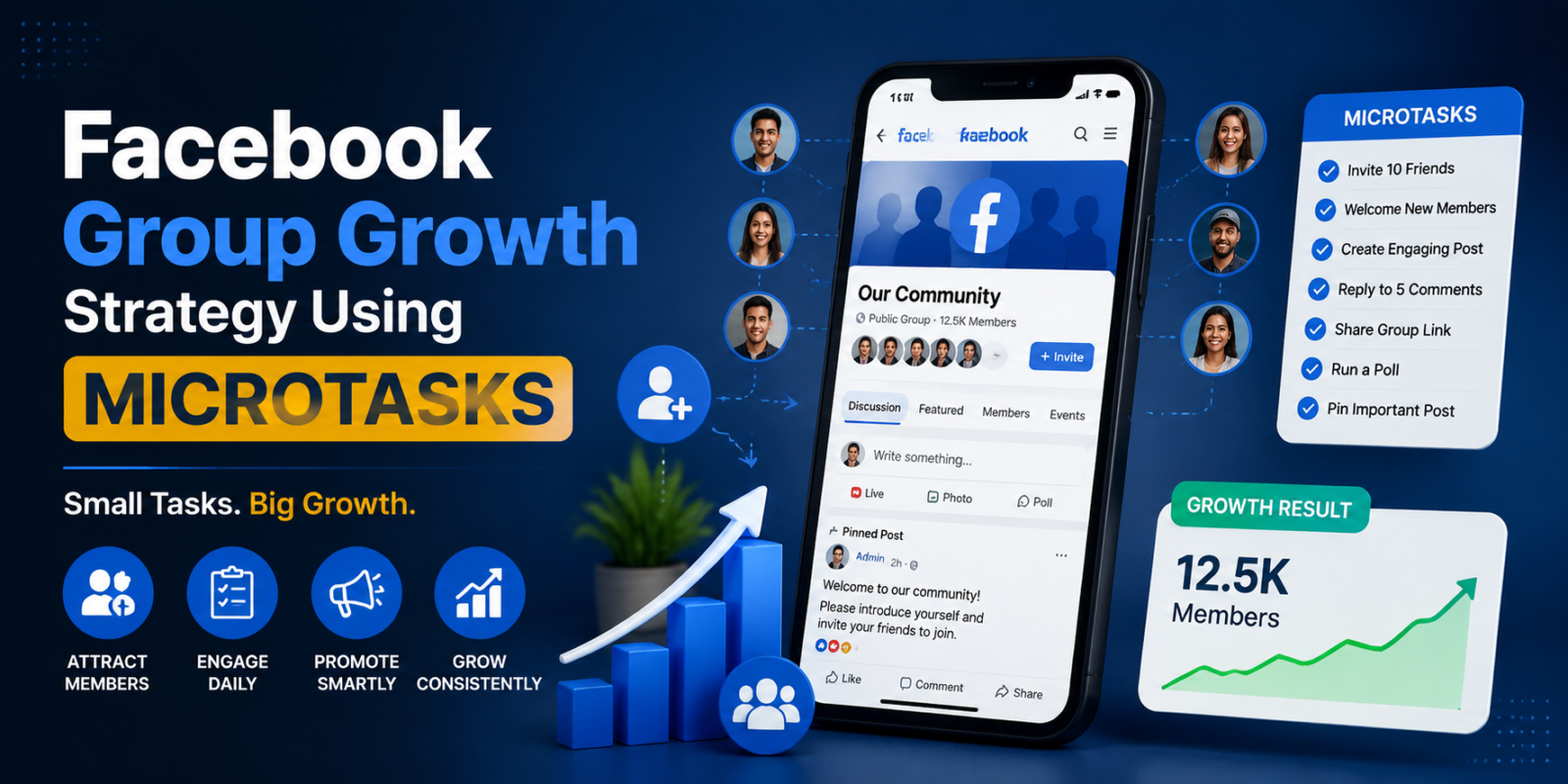
Growing a Facebook Group is less about “getting numbers” and more about building momentum: consistent new members who actually read posts, react, comment, and return. Microtasks can help you accelerate those early signals—especially when your group is new, niche, or struggling to spark conversation.
This article outlines a practical, repeatable approach to using rapidworkers.io to attract real users to join your group, participate in discussions, and help your community reach a self-sustaining growth loop.
What Microtasks Are (and Why They Work for Groups)
Microtasks are small, clearly defined actions completed by people in exchange for a small payment—typically things like joining a group, answering a question, reacting to a post, or leaving a thoughtful comment.
For Facebook Groups, microtasks can help you:
- Seed early engagement so posts don’t look empty
- Test which topics resonate by driving initial discussion
- Improve perceived activity which can increase trust for organic visitors
- Populate your group with diverse viewpoints when targeted correctly
The key is to treat microtasks as a kickstarter, not a replacement for real community management.
Important Ground Rules: Quality, Authenticity, and Compliance
Before using any microtask platform, set guardrails to protect your group’s long-term health:
- Never ask for spam (copy-paste comments, generic “nice post,” irrelevant links).
- Prioritize relevance: recruit people who plausibly care about the topic.
- Use screening questions and moderation to keep quality high.
- Avoid artificial incentives that create low-intent members who never return.
Microtasks should create authentic-looking—and ideally authentic—conversation. That happens when you design tasks that require effort, specificity, and genuine opinions.
Step 1: Prepare Your Group for Conversion
Before you pay anyone to join or engage, make sure the group is “join-ready.” Microtasks work best when new members land in a community that feels active, clear, and welcoming.
Optimize the basics
- Cover image and name: immediately communicate the niche and benefit.
- Description: explain who it’s for, what gets posted, and why it’s valuable.
- Rules: keep them short and enforceable (no self-promo, be respectful, stay on-topic).
- Membership questions: use 2–3 questions that filter for relevance and reduce bots.
Create “landing content”
Pin a post that tells new members exactly what to do next:
- Introduce themselves using a simple template
- Vote in a poll
- Read a short resource list
If microtask workers arrive and see a clear next step, their engagement will look more natural and will be more useful.
Step 2: Set Up a Microtask Funnel (Join → Engage → Contribute)
The biggest mistake is paying for “join group” tasks only. That creates hollow growth. Instead, structure tasks in stages so members take multiple meaningful actions over time.
Stage A: Targeted joins
Goal: bring in people who match the niche. When you create tasks on rapidworkers.io, be specific about eligibility.
- Ask workers to join only if they are interested in the topic
- Require them to answer membership questions thoughtfully (if your group uses them)
- Require proof of completion (e.g., screenshot of “Joined” status or profile name) while respecting privacy and platform rules
Stage B: Light engagement (reactions + votes)
Goal: spark initial signals without forcing fake commentary. Great microtasks here include:
- React to a specific post (like/love/care) based on their opinion
- Vote in a poll and optionally explain why in a comment
- Read a pinned post and comment with one takeaway
Stage C: Real contributions (comments and discussion)
Goal: create threads that other members want to join. Design tasks that require specificity, personal experience, or problem-solving.
- Comment with a personal tip, tool recommendation, or lesson learned
- Answer a question from the admin using 3–5 sentences
- Share a safe, non-promotional resource (no affiliate links; no spam)
Stage D: Member-generated posts (advanced)
Only after you have good moderation and clear rules: ask for a short, original post following a template (e.g., “My challenge, what I’ve tried, what I need help with”). This is powerful, but it must be controlled to avoid low-quality posts.
Step 3: How to Create Effective Tasks on rapidworkers.io
Your task design determines whether you get genuine engagement or disposable activity. Use these principles:
1) Write a tight task brief
- State the goal in one line (e.g., “Join and introduce yourself in our Facebook Group for X”).
- List steps in order.
- Define what “good” looks like (minimum length, specific prompts).
2) Add relevance filters
Examples of filters you can include:
- Language and region (if your group is location-based)
- Interest or experience requirements (e.g., “Only if you run an online store”)
- Age-appropriate topics (where applicable)
3) Use quality controls
- Require a short, unique answer (not copy/paste) to prove effort
- Reject generic comments (tell workers up front what will be rejected)
- Ask them to interact with an existing thread rather than creating noise
4) Pay for quality, not volume
Higher-effort tasks should pay more. This reduces spam and attracts workers willing to contribute thoughtfully.
Microtask Templates You Can Use
Template 1: Join + introduction
Task: Join the group and introduce yourself using our prompt.
- Step 1: Request to join the group.
- Step 2: After approval, comment on the pinned “Welcome” post with: (1) your first name, (2) why you joined, (3) one goal you have.
- Quality rule: Minimum 2 sentences; must be unique and relevant.
Template 2: Poll vote + reason
Task: Vote in the poll and explain your choice.
- Step 1: Vote in the poll.
- Step 2: Comment with 1–3 sentences explaining why.
- Quality rule: No generic comments like “nice” or “great poll.”
Template 3: Answer a discussion question
Task: Reply to a discussion thread with a practical tip.
- Step 1: Read the admin post question.
- Step 2: Comment with a concrete example, tool, or step-by-step suggestion.
- Quality rule: At least 3 sentences or 3 bullet points.
Template 4: Return visit engagement (retention)
Task: Come back in 48–72 hours and reply to someone.
- Step 1: Revisit the group after 2–3 days.
- Step 2: Reply to one member comment with a helpful follow-up.
- Quality rule: Must reference the other person’s point specifically.
Step 4: Combine Microtasks with a Simple Content Engine
Microtasks perform best when you already have consistent posts for workers (and organic members) to engage with. Use a weekly rhythm:
- Monday: Quick win tip + ask a question
- Wednesday: Poll (preferences, challenges, tool choices)
- Friday: “Show your work” thread (wins, progress, lessons)
- Weekend: Resource or discussion prompt
Then assign microtasks to specific posts so engagement concentrates instead of scattering thinly across your feed.
Step 5: Moderate Like a Pro (So Growth Doesn’t Backfire)
As activity increases, moderation becomes your growth lever. To keep the community valuable:
- Approve members in batches and scan profiles for obvious spam patterns.
- Use post approval if you start seeing low-quality submissions.
- Remove promotional links quickly to protect trust.
- Reward good contributors with “Top Contributor” style recognition or shout-outs.
If you notice a microtask campaign bringing in low-intent members, pause and tighten your targeting and prompts.
Measuring Results: What to Track Beyond Member Count
To know whether your microtask strategy is working, track metrics that reflect community health:
- Active members (posting/commenting/reacting)
- Comment depth (threads with back-and-forth replies)
- Posts per day/week from non-admin members
- Approval-to-engagement rate (how many new members engage within 7 days)
- Retention (engagement from the same people 2–4 weeks later)
A smaller group with recurring conversation is more valuable—and grows faster organically—than a large inactive group.
Example 14-Day Microtask Launch Plan
Days 1–3: Foundation
- Set group rules, membership questions, and pinned welcome post.
- Create 3 discussion posts and 1 poll.
Days 4–7: Targeted joins + introductions
- Run a “Join + introduce yourself” microtask.
- Approve members twice per day and reply to intros to model the tone.
Days 8–10: Engagement focus
- Run a poll-vote + explanation microtask.
- Run a “comment with a practical tip” microtask on a key thread.
Days 11–14: Retention and conversation
- Run a return-visit microtask (reply to another member).
- Host a themed discussion day and invite members to share wins/challenges.
Common Mistakes to Avoid
- Buying only joins: creates dead weight and lowers engagement rate.
- Vague prompts: “Leave a comment” leads to low-effort replies.
- No moderation capacity: growth without control invites spam.
- Overusing microtasks: use them to start conversations, then let the community carry them.
- Ignoring member onboarding: without a clear next step, people don’t stick.
Conclusion: Use Microtasks to Create Momentum, Then Let Community Take Over
Using rapidworkers.io for Facebook Group growth can be effective when you design microtasks that encourage real participation, not empty activity. Focus on a funnel that moves people from joining to engaging to contributing, supported by strong onboarding, consistent content, and active moderation.
When done well, microtasks help you cross the hardest threshold in community building: getting enough real conversation that new organic members feel compelled to join in.