
Key Takeaways
- Building custom network marketing MLM software follows a 5-phase process at FlawlessMLM: plan consulting, architecture design, core build, QA testing, and launch support. Skipping any phase costs more than doing it right.
- The commission engine accounts for 30-40% of total development effort. It is the hardest module to build correctly and the most expensive to fix after launch.
- Among the top MLM software companies, only those with 50+ completed MLM projects have the domain expertise to avoid the common engineering mistakes that cost first-time builders months of rework.
Most founders have never built software before. They know their product, their compensation plan, and their market. They do not know what a database schema is or why the commission engine should run as a separate microservice. That knowledge gap is where bad vendor choices and wasted budgets happen.
In my project at FlawlessMLM, I have onboarded over 200 clients through the custom build process. Some arrived with a napkin sketch of their comp plan. Others brought a 40-page specification document. Both types needed the same thing: a clear picture of what happens between the moment they sign a contract and the moment their first distributor logs in.
This guide pulls back the curtain on that process. I will walk through each development phase, explain the technology decisions involved, and share the cost and timeline data from our 400+ completed builds. If you are evaluating MLM software companies for a custom project, this will help you ask the right questions before signing anything.
Phase 1: Compensation Plan Consulting (Week 1-3)
Every custom build at FlawlessMLM starts with compensation plan consulting. Not requirements gathering. Not wireframing. The comp plan comes first because it dictates every architectural decision that follows.
Our specialists map every detail: plan type (binary, unilevel, matrix, or hybrid), rank qualification rules, personal and group volume thresholds, override percentages by level, matching bonuses, pool distributions, and payout caps. Edge cases get documented too. What happens when a distributor demotes mid-period? How does the engine handle volume from a refunded order? What is the maximum possible payout under the worst-case tree structure?
We stress-test the plan math against 10,000+ synthetic scenarios before development begins. Those tests catch margin problems that would become expensive after launch. On 14 projects in 2025, our consulting phase revealed that the client’s proposed plan would pay out more than 50% of revenue under certain tree configurations. We adjusted the rules before any code was written, saving each company from a payout crisis that would have hit within 6-12 months of launch.
Plan consulting takes 2-3 weeks and is included at no additional charge in every FlawlessMLM custom build. If you bring a fully documented plan, the phase shortens to 1 week of verification and stress testing.
“I have built commission engines for 20 years. The single biggest predictor of project success is the quality of the comp plan document that enters the engineering phase. A clear, stress-tested plan produces a clean build with few change orders. A vague plan produces scope creep, missed deadlines, and a commission engine that needs rebuilding within a year. We refuse to start coding until the plan document passes our review. That discipline has kept our on-time delivery rate above 92% across 400+ projects.” Oleksandr Honcharov, CEO at FlawlessMLM
Phase 2: Architecture Design (Week 3-4)
With the plan locked, our engineering team designs the system architecture. This phase determines the technology stack, database structure, API design, and how each module communicates with the others.
Our standard technology stack for MLM multi level marketing software:
- Backend API: PHP/Laravel or Node.js depending on client preference and performance requirements. Laravel handles the majority of our builds. Node.js serves platforms requiring real-time updates like crypto MLM dashboards.
- Frontend (admin and portal): React or Vue.js for the partner portal software and admin panel. Both frameworks produce fast, responsive interfaces that work across devices.
- Database: PostgreSQL for platforms requiring complex queries and high data integrity. MySQL for simpler deployments with lower overhead.
- Commission engine: Runs as an isolated microservice with its own database connection pool. This separation prevents commission calculation load from slowing down the partner portal during period closes.
- Caching: Redis for session management, frequently accessed data, and real-time dashboard updates.
- Hosting: AWS or DigitalOcean with auto-scaling for traffic spikes during launch events and promotion periods.
The architecture phase produces two documents: a technical specification and a database schema diagram. Both get reviewed with the client before development starts. Changing the architecture after coding begins costs 3-5x more than getting it right in this phase.
The database design is particularly important for MLM platforms because genealogy trees create recursive relationships that most standard database patterns handle poorly. A distributor at level 1 sponsors someone at level 2, who sponsors someone at level 3, and so on. Querying volume aggregation across a tree with 100,000 nodes requires careful indexing and query optimization. A naive database design that works fine at 1,000 distributors will grind to a halt at 50,000. Our engineers use adjacency list and nested set patterns depending on tree traversal requirements, with materialized views for commonly accessed aggregations like group volume and team count. These decisions, made in week 3, determine whether the platform runs fast or slow for the next five years.
Phase 3: Core Build (Week 4-10)
Development happens in a specific module sequence. The commission engine ships first because every other module depends on it.
Commission engine (Week 4-6): This is the hardest module to build correctly. It accounts for 30-40% of total development effort on most projects. The engine must handle volume aggregation across the genealogy tree, rank qualification checks, override calculations at configurable depths, matching bonuses across generations, pool distributions, and cap enforcement. Every rule stores as a configurable parameter so the admin team can adjust plan settings without touching code.
Binary MLM software engines require spillover logic and leg balancing calculations. Unilevel MLM software engines need depth-based compression and generation tracking. Matrix MLM software engines enforce width-and-depth limits with cycle and re-entry mechanics. Each plan type demands different algorithms for tree traversal and volume aggregation.
Genealogy tree and enrollment (Week 5-7): The tree module manages position placement, sponsor relationships, and tree integrity. Enrollment flows handle distributor onboarding with compliance steps, product selection, and payment capture. For a network marketing affiliate program, we also configure a simpler enrollment track for casual referrers who do not join the full MLM structure.
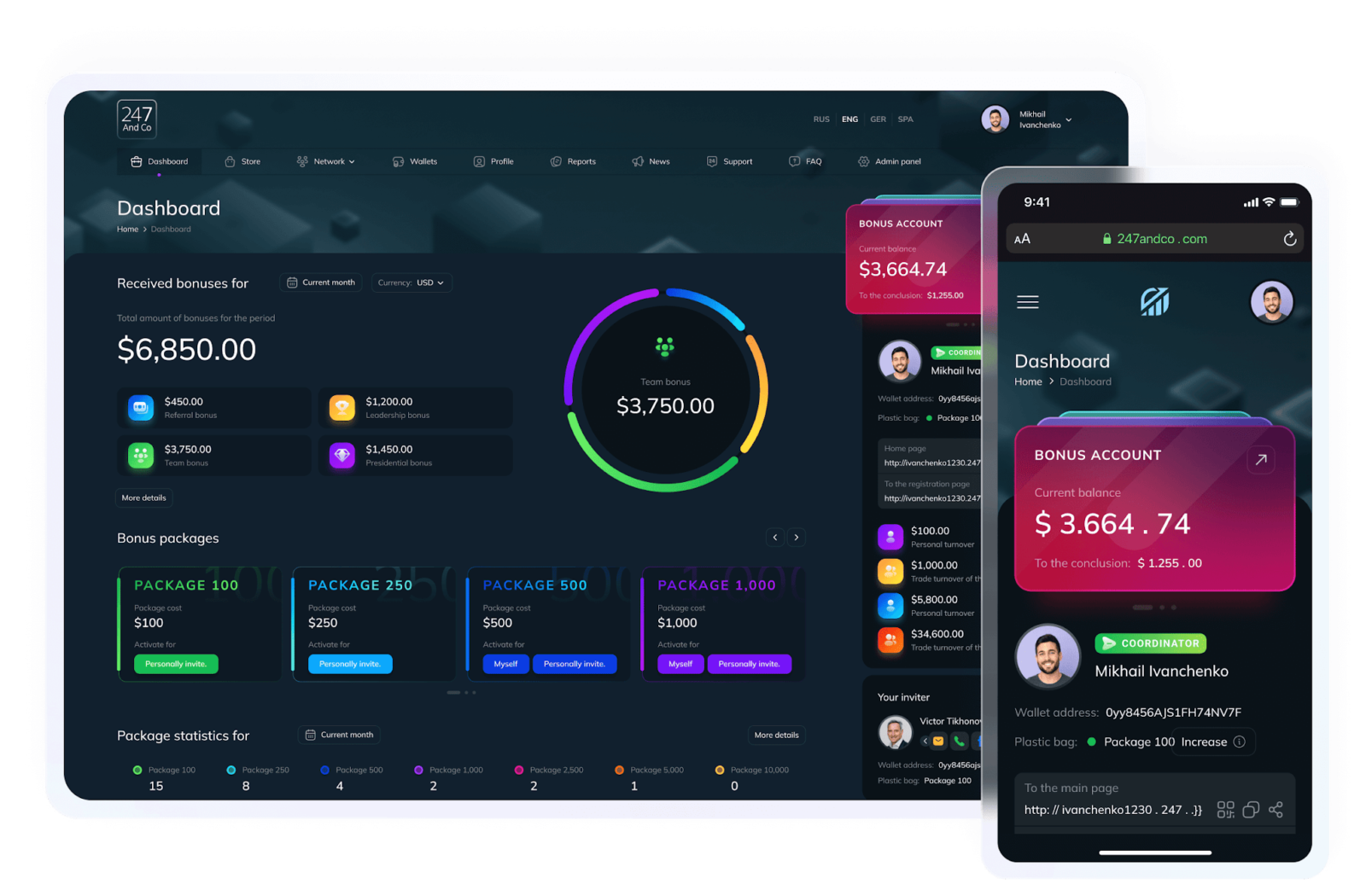
Partner portal and admin panel (Week 6-9): The distributor back office includes commission dashboards, team views, order management, rank tracking, and replicated website controls. The admin panel provides company operators with distributor management, commission run controls, reporting, and plan configuration interfaces. Both pull data from the commission engine through the API.
The partner portal software is where design decisions directly affect distributor behavior. A dashboard that shows the next rank goal with a progress bar and the exact sales needed to qualify drives action. A dashboard that dumps raw numbers in a table does not. We design every portal screen around a single question: what does the distributor need to do next? The answer shapes the layout, the data hierarchy, and the call-to-action on each view.
For MLM affiliate program platforms, we build a simplified portal track for casual affiliates alongside the full distributor portal. Affiliates see their referral link, conversion stats, and payout history. Full distributors see everything affiliates see plus the genealogy tree, team management, autoship controls, and rank qualification details. Both tracks live in the same partner management system and share the same authentication layer.
Integrations (Week 7-9): Payment gateways, shipping providers, CRM connectors, and email marketing tools connect through API integrations. Each gateway requires its own implementation, testing, and error handling. We maintain pre-built connectors for Stripe, PayPal, and 12 additional regional processors that accelerate the integration phase.
Phase 4: QA and Commission Verification (Week 9-11)
Testing is not optional and it is not something we rush. The QA phase runs 10,000+ test scenarios against the commission engine, walks through every enrollment flow on every supported device, verifies payment processing with test transactions, and confirms that the partner management system displays accurate data under load.
Commission verification is the most critical testing step. We run the engine against synthetic data sets that cover every rule in the plan document. Every payout must match the expected result within $0.01. Discrepancies get traced to their root cause and fixed before the next test run. Most builds require 2-3 test iterations to resolve all edge cases.
We also run load tests simulating 10x the expected launch traffic. MLM launches tend to spike hard. A company announcing at a convention can see 5,000 enrollment attempts in a single hour. The platform must handle that surge without degrading performance for existing users.
Among our 400+ projects at FlawlessMLM, the QA phase catches an average of 23 issues per build before launch. Of those, 3-5 are commission calculation edge cases that would have produced incorrect payouts. The remaining 18-20 are UI, performance, or integration issues. Every issue found in QA saves an estimated 10x the cost of fixing it post-launch when live data and real distributors are involved. (FlawlessMLM Internal Data, 2025)
Phase 5: Launch and Post-Launch Support (Week 10-14)
Go-live follows a structured checklist. DNS configuration, SSL certificates, production database migration, payment gateway activation, and email deliverability verification all happen in a specific sequence. We schedule launches at the start of a new commission period so distributors begin on a clean slate.
The go-live day itself is the least dramatic part of the process when the earlier phases are done right. The platform has been running in a staging environment for weeks. Test transactions have verified every payment path. Commission calculations have been validated against 10,000+ scenarios. Launch day is a DNS switch and a monitoring watch, not a prayer.
FlawlessMLM provides 24/7 support for the first 72 hours after launch. Our engineers monitor server performance, commission engine processing, and payment transactions in real time. Any issue gets escalated immediately. We also set up a direct communication channel with the client’s operations team so questions get answered in minutes, not hours.
The first two commission periods on the new platform get extra scrutiny. We compare every payout against expected calculations and resolve discrepancies within 24 hours. This parallel verification catches data import issues that testing with synthetic data could not predict. On 8 of our last 50 launches, the first live commission run revealed a data quality issue in the imported distributor records that affected volume calculations for 2-5% of positions. Our parallel check caught and corrected each one before payouts processed.
Post-launch support continues for 30 days at no additional charge on every FlawlessMLM build. Extended support agreements run $800-$1,500/month with a dedicated account manager.
Build vs. Buy: When Custom Makes Sense
Custom MLM software is not the right choice for every company. SaaS affiliate software and off-the-shelf MLM platforms serve startup networks well when the comp plan fits a standard template and the distributor count stays under 5,000.
Custom becomes the better investment when any of these conditions apply:
- Your compensation plan has rules that SaaS tools cannot configure natively
- You need full source code ownership to avoid vendor lock-in
- Your network will exceed 10,000 distributors within 24 months
- You operate in multiple countries requiring different compliance rules
- Your MLM affiliate program needs a hybrid affiliate and multi-level structure
The MLM software price for a custom build at FlawlessMLM starts at $8,500 for a starter package and ranges to $120,000+ for enterprise deployments. The investment includes full source code, comp plan consulting, QA testing, and 30 days of post-launch support.
Code ownership is the hidden advantage that most MLM software price comparisons overlook. With a custom build, the company owns every line of code. When the original vendor relationship ends for any reason, the platform continues running on the company’s own servers. SaaS and affiliate management platform subscriptions create permanent dependency. Cancel the subscription and the entire platform disappears, taking distributor data, commission history, and the genealogy tree with it. For a company with 20,000 active distributors, that dependency represents existential risk.
FlawlessMLM holds a 4.9 rating on Clutch and has delivered the best network marketing software for over 400 clients since 2005. Our 92% on-time delivery rate comes from a process that prioritizes plan accuracy over speed. We would rather delay a launch by two weeks than ship a commission engine that pays wrong on the first run.
We offer a free project scoping consultation. Our team will review your comp plan, estimate the build timeline, and provide a fixed-price quote with milestone payments.
FAQ
How long does it take to build custom MLM software?
Custom MLM software takes 6 to 24 weeks from kickoff to launch depending on scope. A single-plan platform launches in 6 to 8 weeks at FlawlessMLM. Mid-range builds with mobile apps and multi-currency take 10 to 16 weeks. Enterprise platforms with hybrid plans and global compliance take 16 to 24 weeks.
Should I hire a freelancer or an MLM software company to build my platform?
An MLM software company with direct selling domain expertise delivers a more accurate commission engine and a faster build. Commission calculations and genealogy tree logic require familiarity with how compensation plans work in practice. A freelancer who has never built MLM software spends weeks learning the domain before writing useful code. At FlawlessMLM, our engineers have configured over 400 compensation plans.
What technology stack should MLM software use?
At FlawlessMLM, we use PHP/Laravel or Node.js for the backend, React or Vue.js for the frontend, PostgreSQL or MySQL for the database, and Redis for caching. The commission engine runs as an isolated microservice. Mobile apps use React Native for hybrid and Swift/Kotlin for native. Cloud hosting on AWS or DigitalOcean provides scalability for traffic spikes.
What is included in a minimum viable MLM platform?
Five core modules: a commission engine for one plan type, genealogy tree with position management, distributor enrollment and back office, admin panel, and payment gateway integration. FlawlessMLM starter packages at $8,500 include all five and launch in 4 to 8 weeks. Optional modules like autoship, mobile apps, and multi-currency can be added post-launch.
Do I own the source code of custom MLM software?
At FlawlessMLM, every custom build includes full source code ownership. You receive the complete codebase, database schema, and deployment documentation. You can host on your own servers, modify code with your own developers, or switch vendors without losing access. SaaS MLM platforms retain all IP and you lose everything if you cancel.