
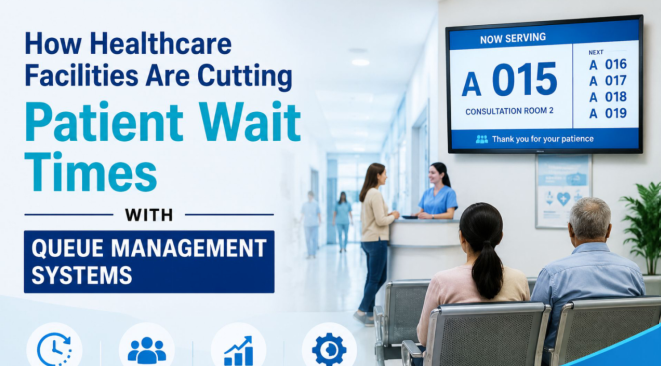
What happens if a patient shows up 15 minutes before their appointment and sits in the waiting room until almost a full hour before they get a chance to see a doctor? If you treat hundreds of patients a day, this may sound like normal for you, but it’s costing your business more than you realize in the long run!
A patient might take this incident as normal for the first time, but if it becomes a habit in hospitals, patients may walk out and will never trust your services again. Rising patient volumes, staffing challenges, and growing expectations for faster services are pushing the healthcare industry to think twice for their patients’ convenience. Hospitals are not merely looking for additional employees or extra waiting rooms, but at patient flow.
One of the biggest changes driving that shift is the adoption of queue management systems.
Let’s explore in the following blog how a healthcare queue management system is helping hospitals reduce their patient wait times for maximized patient satisfaction and seamless service delivery.
Why long wait times remain a challenge in healthcare
Healthcare operations are far more unpredictable than most industries. A clinic may start the day with a full appointment schedule, only to deal with emergencies, late arrivals, walk-ins, and consultations that run longer than expected.
Patient demand is harder to predict than it looks
Several patients may show up at the same time or one appointment may go over time, and a well-planned schedule can go awry in a hurry. It’s a domino effect, with the consequence of fewer people being registered, fewer consultations, and more wait times in the waiting room.
Minor issues become major issues throughout the day
It may only be five minutes at check-in, but multiply that by dozens or hundreds of patients and the minutes begin to add up. By the afternoon, the staff catches up, patients become frustrated, and the whole schedule seems hurried.
The problem is rarely one person or one department. It’s the flow between them.
Patients judge more than clinical care
Healthcare leaders often focus on clinical outcomes, and rightly so. But patients experience a healthcare visit differently.
Waiting shapes the patient experience
Most patients do not evaluate the technical quality of care. They are noticing practical things:
- How long did they wait
- Whether the visit felt organized
- If the staff kept them informed
- Whether the process felt stressful or smooth
Even if someone has a great medical experience, a patient who waits 45 minutes without knowing what’s happening could come away with a bad feeling.
The uncertainty can be worse than the delay!
People can usually tolerate waiting when they understand what is happening. The thing that bothers them is that they don’t know whether they’ll be seen in 5 minutes or 50 minutes.
That is why communication has become a major aspect of patient flow management in the current scenario.
The move from waiting room management to patient flow management.
For years, many facilities have attempted to alleviate delays by increasing their staffing, adding more reception desks, and adding more chairs during rush hours. Occasionally, it did, for a while. Many times it didn’t cure the problem.
A bigger waiting room does not fix a workflow problem
When patients are stuck at registration, misdirected to the wrong department, or delayed due to unavailable personnel, it is not a spatial problem; it is an operational problem.
Healthcare organizations are now considering the patient journey as a whole rather than waiting for it to become a standalone issue.
How queue management systems are reducing patient wait times
A queue management system is a tool that can be used to manage queues in healthcare systems, including hospitals, clinics, and other medical facilities.
Faster check-ins reduce early bottlenecks
Digital registration, mobile check-in, and self-service kiosks enable patients to finish mundane processes promptly. Patients don’t have to wait in long lines at reception to get to the next phase of their visit.
For front-desk teams, that means less congestion during peak arrival times and fewer repetitive administrative tasks.
Virtual queues reduce crowded waiting rooms
Many facilities now allow patients to join a digital queue and receive updates on their phones. Patients can wait more comfortably instead of sitting in a packed lobby, wondering when their name will be called.
This approach has become especially valuable in busy outpatient clinics and diagnostic centers where patient turnover is high.
Automated updates keep patients informed
Simple notifications can make a surprisingly big difference. Patients receive updates about:
- their queue position,
- estimated wait times,
- appointment reminders,
- and when it is their turn to proceed.
This transparency takes away anxiety and decreases the ongoing “How much longer?” questions to staff.
Effective appointment management makes for more efficient days.
Scheduling tools are also part of a queue management platform that can help facilities even out their appointments throughout the day. A properly balanced patient arrival helps clinics avoid extreme peaks that stress staff and cause long wait times.
The benefits go beyond shorter waits
The major advantage is reduced waiting time, but healthcare centers may see further benefits as well.
Staff spend less time managing frustration
Reception teams no longer have to answer the same questions repeatedly. Nurses and administrative staff face fewer interruptions, which helps the entire facility operate more calmly and efficiently.
Managers gain better visibility into operations
Instead of relying on assumptions, administrators can see where delays are happening in real time. They can identify peak demand periods, recurring bottlenecks, and departments that need workflow adjustments.
That kind of visibility changes operational decision-making from guesswork to evidence-based planning.
What healthcare facilities are learning from queue data
One of the most interesting outcomes of digital queue management is the data it provides.
The biggest bottlenecks are not always where expected
Some facilities discover that registration is not the main issue at all. Others find that a specific department consistently slows down patient flow during certain hours.
Without data, these problems are hard to see clearly. With data, they become measurable and fixable.
The future of patient waiting is changing
Patients now demand the same level of organization and transparency of service that they associate with other services in their lives. They seek clarity, consistency, and fewer moments of waiting in limbo.
Healthcare facilities are taking steps to redesign workflows around convenience and visibility, and not just clinical care.
Queue management systems are a part of that transformation.
Conclusion
Healthcare facilities will always have unexpected needs, urgent cases and complex schedules to manage. Waiting cannot disappear entirely. But unnecessary waiting can.
The organizations making the biggest improvements are not simply trying to move patients faster. They are creating a more organized, transparent, and patient-friendly experience from the moment someone walks through the door.
Queue management systems are helping hospitals, clinics, and diagnostic centers do exactly that — reducing delays, improving communication, and giving healthcare teams better control over daily operations.
In the end, patients may not remember every detail of their treatment. But they will remember whether the experience felt smooth, respectful, and well-managed.