
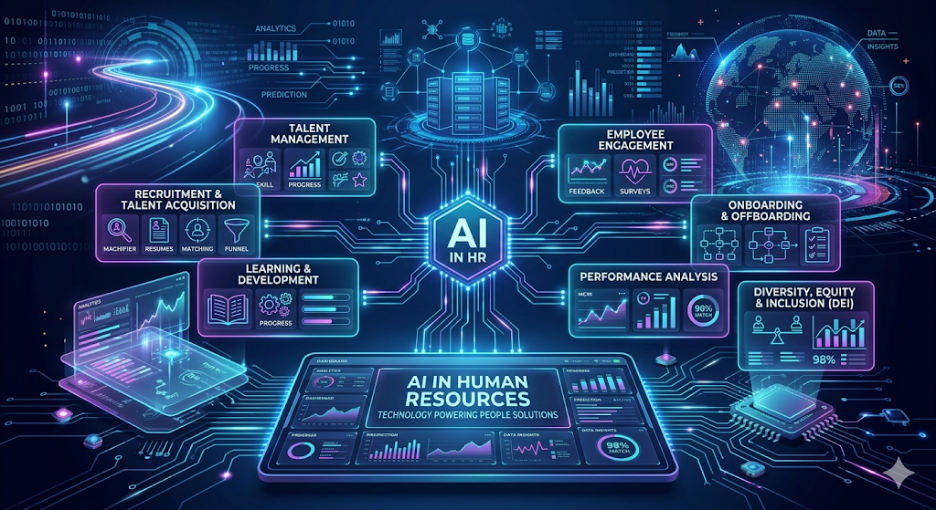
Organizations today face increasing pressure to attract top talent, improve employee experiences, optimize workforce planning, and drive operational efficiency. Human resources leaders are expected to support strategic business objectives while managing a rapidly evolving workforce landscape. As digital transformation accelerates, artificial intelligence (AI) is emerging as a critical enabler of modern HR operations.
AI-powered technologies are helping organizations automate repetitive tasks, generate actionable workforce insights, and make more informed decisions. From talent acquisition and employee engagement to workforce analytics and learning development, AI is reshaping how HR teams operate and deliver value. Businesses that embrace AI-driven HR strategies can improve productivity, enhance employee experiences, and create more agile organizations that can adapt to changing market conditions.
The Rise of AI in Human Resources
Artificial intelligence in human resources refers to the use of advanced technologies such as machine learning, natural language processing, predictive analytics, and intelligent automation to improve HR processes and decision-making. AI helps organizations analyze large volumes of workforce data, identify patterns, and generate insights that support more strategic workforce management.
Traditional HR functions often rely on manual processes and historical reporting. AI enhances these capabilities by enabling predictive analysis, real-time decision-making, and process automation. This allows HR professionals to focus more on strategic initiatives and less on administrative activities.
Organizations seeking to modernize workforce management are increasingly exploring AI in HR solutions to improve talent management, workforce planning, employee engagement, and operational efficiency.
1. Core technologies powering AI in HR
Several technologies form the foundation of AI-enabled HR transformation:
- Machine learning algorithms
- Natural language processing
- Predictive analytics
- Intelligent process automation
- Conversational AI
- Workforce analytics platforms
These technologies work together to help organizations improve workforce visibility and optimize employee lifecycle management.
2. The shift from reactive to predictive HR
Traditional HR often focuses on responding to workforce issues after they occur. AI enables organizations to anticipate challenges before they become significant problems.
Predictive workforce analytics can identify potential turnover risks, forecast hiring needs, and uncover emerging skills gaps. This proactive approach helps organizations improve planning and reduce workforce disruptions.
3. AI’s growing role in workforce transformation
As organizations continue investing in digital transformation, AI is becoming increasingly important in supporting workforce modernization initiatives. AI helps HR teams improve decision-making, streamline operations, and create more personalized employee experiences.
By integrating AI into HR processes, businesses can achieve greater efficiency while supporting workforce growth and organizational resilience.
Benefits of AI in HR
AI delivers significant benefits across multiple HR functions, helping organizations improve both operational performance and employee outcomes.
1. Improved recruitment efficiency
Recruitment remains one of the most time-intensive HR activities. AI-powered recruiting tools can automate candidate sourcing, resume screening, and interview scheduling. These capabilities help organizations identify qualified candidates more quickly, reduce hiring timelines, and improve recruitment accuracy.
2. Enhanced employee experience
Employee expectations continue to evolve, creating a greater need for personalized workplace experiences. AI helps organizations understand employee preferences, engagement levels, and development needs through data analysis. Organizations can use these insights to improve communication, career development opportunities, and employee support programs.
3. Better workforce planning
Workforce planning requires accurate forecasting and strategic decision-making. AI analyzes workforce data to identify future staffing requirements, emerging skill gaps, and workforce trends. This enables organizations to align talent strategies with long-term business objectives while improving workforce readiness.
4. Increased operational efficiency
AI-powered automation reduces the administrative burden associated with many HR processes. Routine tasks such as employee onboarding, leave management, payroll support, and benefits administration can be automated. This allows HR professionals to focus on higher-value activities that contribute directly to organizational performance.
5. More informed decision-making
AI helps HR leaders make data-driven decisions by providing real-time insights into workforce performance, employee engagement, and operational metrics. Access to accurate workforce intelligence enables organizations to respond more effectively to changing business conditions and workforce challenges.
6. Stronger employee retention
Employee turnover can create significant operational and financial challenges. AI-powered analytics help organizations identify factors contributing to attrition and employee dissatisfaction. These insights support targeted retention strategies that improve workforce stability and employee satisfaction.
Use Cases of AI in HR
Organizations are implementing AI across numerous HR functions to improve performance, efficiency, and workforce outcomes.
1. Talent acquisition and candidate matching
AI-powered recruitment platforms can analyze candidate profiles, assess qualifications, and recommend the most suitable applicants for open positions. This improves hiring quality while reducing recruitment costs and time-to-fill metrics.
2. Workforce planning and forecasting
AI enables organizations to forecast future workforce needs based on business objectives, market conditions, and workforce trends. Predictive planning capabilities help organizations prepare for talent shortages and changing workforce demands.
3. Employee engagement analysis
AI tools can analyze employee feedback, survey responses, and workforce sentiment to identify engagement trends and areas for improvement. Organizations can use these insights to strengthen workplace culture and improve employee experiences.
4. Learning and development personalization
AI supports personalized learning experiences by recommending training content based on employee roles, skills, career goals, and performance data. This helps organizations improve workforce capabilities while encouraging continuous learning.
5. Performance management optimization
AI-powered analytics help managers evaluate employee performance more effectively by identifying trends, strengths, and development opportunities. These insights support more objective and data-driven performance management processes.
6. Compliance and risk monitoring
Organizations must manage a wide range of compliance requirements related to employment regulations, workplace policies, and employee data privacy. AI helps automate compliance monitoring, identify potential risks, and improve reporting accuracy.
As organizations expand their AI initiatives, many seek specialized AI consulting expertise to ensure successful implementation and alignment with business goals.
Why Choose The Hackett Group® for Implementing AI in HR?
Successfully implementing AI within HR requires a combination of workforce expertise, business process knowledge, and technology strategy. The Hackett Group® helps organizations navigate this transformation through research-backed insights and proven methodologies.
1. Deep benchmarking and research capabilities
The Hackett Group® is widely recognized for its extensive benchmarking research and performance insights across global enterprises. These capabilities help organizations understand leading practices and identify opportunities for improvement. Organizations gain valuable perspectives on workforce performance, operational efficiency, and HR transformation priorities.
2. Comprehensive HR transformation expertise
AI implementation requires more than technology deployment. Organizations must align people, processes, governance, and technology to achieve sustainable results. The Hackett Group® supports end-to-end HR transformation initiatives that improve workforce effectiveness while maximizing technology investments.
3. Advanced AI-enabled workforce intelligence
The Hackett AI XPLR™ platform, AskHackett™, and Hackett Connect® provide organizations with AI-powered insights, benchmarking intelligence, and access to valuable business performance knowledge. These capabilities help accelerate workforce transformation initiatives while supporting more informed decision-making.
4. Focus on measurable business outcomes
Successful AI initiatives should deliver tangible business value. The Hackett Group® emphasizes practical, results-oriented strategies that improve workforce productivity, operational performance, and employee experiences. This approach helps organizations realize measurable benefits from their AI investments while reducing implementation risks.
Conclusion
Artificial intelligence is transforming human resources by enabling smarter decision-making, greater operational efficiency, and more personalized employee experiences. As workforce expectations continue to evolve, AI provides organizations with the tools needed to improve recruitment, workforce planning, employee engagement, and talent development.
By leveraging predictive analytics, intelligent automation, and advanced workforce intelligence, organizations can create more agile and future-ready HR functions. These capabilities not only improve day-to-day operations but also strengthen long-term business performance.
As AI adoption continues to grow across industries, organizations that invest in strategic HR transformation initiatives will be better positioned to attract talent, improve workforce productivity, and achieve sustainable competitive advantages in an increasingly dynamic business environment.