
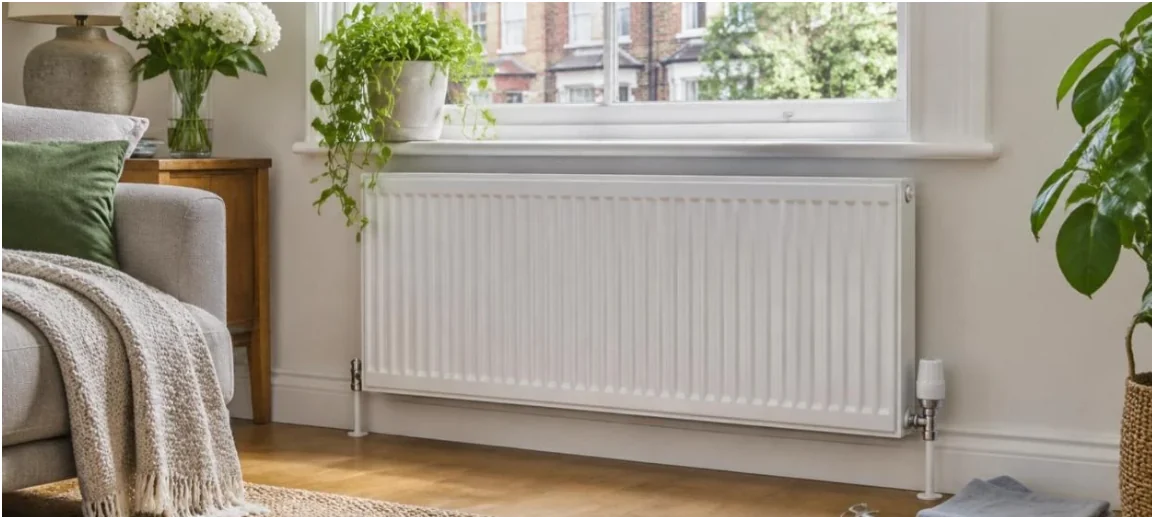
The boiler is on, the pipes hum and every radiator in the house is warm except one. You place your hand on it and feel only a cold panel. A radiator not heating up is one of the most common heating complaints, and the cause is often simpler than people fear.
Most cold radiators come down to air, a stuck valve or sludge in the system. The pattern of the cold area tells you which one you have.
Switch the heating on and wait 20 minutes. Then feel the radiator in three places.
If the top is cold and the bottom is warm, air is trapped inside. If the bottom is cold and the top is warm, sludge has collected at the base. If the whole panel is cold, the water is not reaching it, which usually means a valve problem.
Take a radiator in a back bedroom with a cold top half. That alone points to trapped air, so you can skip the more complicated checks.
Cold at the top means air
Air collects at the top of a radiator and stops hot water from filling the panel. The fix is simple. Bleeding a radiator lets the air escape so the water can rise.
You need a radiator key, a cloth and a few minutes. Turn the heating off first and let the radiator cool. Place the cloth under the bleed valve, turn the key a quarter turn anticlockwise and listen for the hiss. When water starts to appear, close the valve again.
After bleeding, check the pressure on your boiler gauge. Bleeding lets air out, and a pressure drop may need topping up on some systems. Follow the boiler’s manual for that step.
Cold at the bottom means sludge
Sludge is a mix of rust and dirt that settles at the bottom of radiators over the years. It blocks the flow, so the lower part stays cold. Bleeding does not help here.
A professional power flush or system clean removes it. Cleaning also protects the boiler, because sludge that circulates can damage the pump and the heat exchanger. If several radiators are cold at the bottom, the whole system is probably affected.
Fully cold usually means a valve
A radiator with no heat at all often has a stuck valve. There are two valves on most radiators. One is the thermostatic head, the other is the lockshield valve on the opposite side.
Remove the thermostatic head and look at the small pin inside the valve body. A pin that is stuck in the down position blocks water. Gently free it with pliers, and refit the head. Check also that the head is not set to the lowest number.
The lockshield valve controls balance, so only adjust it if you know how. Closing it too far can starve a radiator, and opening it too far can starve the others.
When the whole system is the problem
Sometimes every radiator is cold. In that case, check the boiler first. Look at the pressure gauge, the display and the thermostat. A boiler at low pressure, or one that is locked out with a fault code, will not send hot water around the house.
Check that the timer and the room thermostat are calling for heat. A programmer left on the wrong mode is one of the more embarrassing causes, and it takes a minute to check.
Why one radiator goes cold while the others stay warm
If a single radiator fails and the rest work, the fault sits at that radiator or its pipes. The boiler and pump are fine, since they feed all the others. This helps you avoid a costly call to the wrong specialist.
Think of the heating system as a loop of water. Every radiator is a branch off that loop. A blockage in one branch leaves the main loop untouched. Look for the branch problem first, and the whole-system causes only if several radiators behave the same way.
Know the limits of a DIY fix
Bleeding a radiator and freeing a valve pin are safe jobs for most homeowners. Anything involving the boiler’s gas side, the flue or removing a radiator from the wall is different. Gas work must be done by a Gas Safe registered engineer.
Call for help if the same radiator goes cold again within days, if water leaks from the valve or if you see rust stains around the pipes. These point to a fault that bleeding cannot cure.
Prevent it next winter
Bleed your radiators once at the start of the heating season and again in mid-winter if you notice cold tops. Keep a radiator key in a kitchen drawer. A yearly boiler service helps too, because the engineer can test the water quality in the system.
A little attention each autumn keeps the cold spots away, and means you never have to ask why one room feels like a different house.