
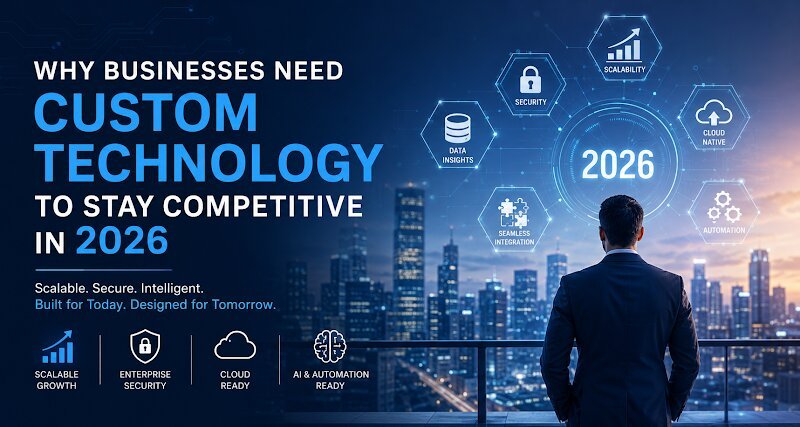
Businesses entering 2026 are operating in an environment where digital infrastructure directly influences growth, customer retention, operational efficiency, and long term competitiveness. Technology is no longer functioning as a support layer behind the business. It has become part of the business model itself.
Many organizations initially scale using disconnected tools, generic SaaS subscriptions, spreadsheets, and lightweight applications built for immediate needs rather than long term growth. While this may work during early stages, the limitations become visible as operations expand. Teams begin struggling with fragmented data, slow workflows, poor system integration, inconsistent reporting, and rising operational overhead.
In my experience, one of the most common reasons businesses hit operational bottlenecks is not lack of ambition or market demand. It is software architecture that was never designed for scale.
This is why many organizations are increasingly investing in enterprise-grade digital ecosystems supported by properly planned custom software development services that align with their long term operational strategy rather than temporary functionality requirements.
At the same time, customer expectations continue to evolve rapidly. Users now expect seamless digital experiences across devices, locations, and channels. Businesses that fail to deliver consistent experiences across mobile and web environments often struggle to maintain engagement and operational agility. As a result, scalable platforms supported by custom mobile application development services are becoming critical components of modern business infrastructure.
The businesses that stay competitive in 2026 will not necessarily be the ones with the largest budgets. They will be the organizations that build adaptable, scalable, and intelligent technology foundations capable of evolving with market demands.
The Importance of Enterprise-Grade Applications
Enterprise-grade applications are fundamentally different from short term or utility-focused software.
They are designed with scalability, resilience, performance, and integration in mind from the beginning. Their goal is not simply to solve today’s operational issue. Their purpose is to support business growth for years without forcing major rebuilds every time requirements evolve.
Many growing businesses eventually encounter problems such as:
- Systems slowing down as user volume increases
- Data inconsistencies across departments
- Poor visibility into operations
- Manual processes consuming employee time
- Difficulty integrating third-party tools
- Security vulnerabilities caused by fragmented infrastructure
- Rising maintenance costs due to outdated architecture
These problems are often symptoms of foundational technology decisions made too early without considering long term scalability.
Enterprise-grade applications reduce these risks by creating a stable digital foundation that supports continuous growth.
What Defines Enterprise-Grade Applications
Scalability
Scalability is one of the most critical characteristics of modern software systems.
A scalable application can handle increasing users, transactions, data volume, and operational complexity without major degradation in performance.
Businesses frequently underestimate how quickly software demands evolve. A platform initially designed for hundreds of users may suddenly need to support thousands of concurrent transactions, multiple geographic regions, or entirely new service models.
Without scalable architecture, growth itself becomes a technical problem.
Scalable applications are designed with flexibility in mind, allowing infrastructure and functionality to evolve incrementally rather than requiring complete redevelopment.
Security
Security is no longer optional infrastructure.
Businesses today handle sensitive operational, financial, and customer data across multiple platforms and devices. Weak security architecture can lead to financial losses, compliance risks, operational downtime, and reputational damage.
Enterprise-grade applications incorporate security into the architecture itself rather than treating it as an afterthought. This includes secure authentication systems, role-based permissions, encrypted communication, secure APIs, monitoring systems, and proactive vulnerability management.
As AI adoption and automation increase, security requirements will continue becoming more sophisticated.
Performance
Performance directly affects customer experience and operational productivity.
Slow systems frustrate users, reduce employee efficiency, and negatively impact business outcomes. In competitive markets, poor performance often translates into lost revenue.
Modern enterprise applications are optimized for responsiveness, high availability, and efficient resource management. Performance optimization is especially important for businesses managing real-time operations, mobile interactions, large databases, or cloud-based ecosystems.
Reliability
Reliable systems create operational confidence.
Downtime affects more than technology. It impacts customer trust, revenue continuity, employee productivity, and business reputation.
Enterprise-grade applications are designed with redundancy, monitoring, backup strategies, and failover capabilities to minimize operational disruption.
Reliability becomes even more important when businesses depend on digital platforms for core operations such as logistics, healthcare, education, finance, or customer service.
Integration Capabilities
Modern businesses rarely operate using a single platform.
They rely on CRMs, ERP systems, payment gateways, analytics tools, communication platforms, AI systems, and third-party APIs.
Applications that cannot integrate efficiently often create isolated data environments and operational inefficiencies.
Enterprise-grade systems prioritize interoperability and API-driven architecture to support seamless communication between platforms.
Key Pillars for Long-Term Growth
Modular Architecture
One of the most important strategic decisions businesses face is choosing between monolithic and modular architecture.
Traditional monolithic systems place all functionality inside a single codebase. While easier to launch initially, they often become difficult to maintain and scale as complexity increases.
Modular or microservices-based architectures divide applications into independent services that can evolve separately.
This creates several advantages:
- Faster feature deployment
- Easier scalability
- Improved fault isolation
- Better maintainability
- Greater flexibility for future integrations
Not every business requires full microservices architecture immediately. However, designing systems with modularity in mind significantly improves long term adaptability.
Cloud-Native Development
Cloud-native development has become essential for businesses prioritizing agility and scalability.
Cloud infrastructure allows organizations to scale resources dynamically, improve deployment speed, reduce hardware dependency, and support distributed teams more efficiently.
Cloud-native applications also support faster disaster recovery, improved monitoring, and better global accessibility.
Businesses relying on legacy on-premise systems often struggle to compete with organizations using cloud-native ecosystems that can evolve rapidly.
Data-Driven Decision Making
Businesses generate enormous amounts of operational data, but many organizations still lack visibility into actionable insights.
Future-ready applications prioritize centralized data architecture, analytics integration, and reporting capabilities that support real-time decision making.
This enables leadership teams to:
- Identify operational inefficiencies
- Improve customer experiences
- Forecast business trends
- Optimize resource allocation
- Measure performance accurately
Data visibility is becoming a competitive advantage rather than a reporting function.
Automation and AI Readiness
AI adoption is accelerating across industries, but many businesses are discovering that outdated infrastructure limits their ability to implement automation effectively.
Future-ready systems are designed to support AI integrations, workflow automation, predictive analytics, and intelligent decision support.
Businesses that modernize infrastructure early will be significantly better positioned to adopt emerging technologies without major redevelopment costs later.
Common Mistakes Businesses Make
Short-Term Development Mindset
One of the most expensive mistakes organizations make is prioritizing speed over architecture.
Businesses sometimes choose quick solutions that solve immediate operational problems but create technical debt over time.
While short-term development may reduce initial costs, it often increases long-term maintenance expenses, redevelopment costs, and operational limitations.
Ignoring Scalability Early
Scalability should not be treated as a future concern.
By the time scaling issues become visible, businesses are often forced into expensive restructuring projects that disrupt operations.
Planning for scalability early allows businesses to expand gradually without major infrastructure instability.
Choosing the Wrong Tech Stack
Technology selection directly affects scalability, performance, security, hiring flexibility, and long term maintenance.
Choosing technologies based solely on trends or short-term convenience can create future limitations.
The best technology decisions align with business goals, operational complexity, projected growth, and integration requirements.
Best Practices for Building Future-Ready Applications
Strategic Planning Before Development
Successful software projects begin with strategic planning rather than immediate development.
Businesses should evaluate:
- Long-term operational goals
- User growth expectations
- Integration requirements
- Security and compliance needs
- Reporting and analytics priorities
- Future automation goals
Technology architecture should support business evolution, not restrict it.
Choosing the Right Development Partner
The quality of architectural planning often determines whether a platform remains scalable five years later.
Businesses should prioritize partners who understand operational strategy, scalability planning, cloud architecture, security, and long term maintainability rather than focusing only on coding execution.
Strong consultation during early planning phases frequently prevents expensive redevelopment later.
Continuous Optimization and Iteration
Technology ecosystems should evolve continuously.
Future-ready businesses regularly optimize performance, modernize infrastructure, monitor security risks, and refine user experiences based on operational insights.
Digital transformation is not a one-time project. It is an ongoing process of adaptation and improvement.
Real-World Example of Architecture Driving Growth
I have seen organizations experience rapid operational improvements simply by restructuring fragmented systems into unified digital ecosystems.
One mid-sized service business was previously operating with disconnected scheduling software, spreadsheets, customer databases, and manual reporting workflows. As customer demand increased, operational inefficiencies became difficult to manage.
Instead of adding more standalone tools, the company invested in a centralized platform with integrated scheduling, reporting, customer management, and mobile accessibility.
The result was not just operational convenience.
The business reduced manual administrative work significantly, improved reporting visibility, accelerated customer response times, and created a scalable infrastructure capable of supporting expansion into additional markets.
The key improvement was not the interface itself. It was the underlying architecture designed for scalability and operational continuity.
Conclusion
Businesses entering 2026 are facing increasing pressure to move faster, operate smarter, and adapt continuously.
Technology decisions now influence scalability, operational resilience, customer experience, and long term competitiveness more than ever before.
Organizations relying on fragmented tools and short-term infrastructure often encounter limitations that eventually slow growth and increase operational complexity.
In contrast, businesses investing in scalable, secure, and future-ready applications position themselves for sustained adaptability in rapidly evolving markets.
The most successful organizations are not simply adopting more technology. They are investing in better technology architecture designed to evolve alongside their business objectives.
In the years ahead, competitive advantage will increasingly belong to businesses that treat technology as strategic infrastructure rather than temporary operational support.