
There are many AI tools for game creation in 2026, and they are not interchangeable. Most of them are built primarily around mechanical specifications — tools designed to turn a description of game systems into working code or assets. These tools are excellent for what they do, but they approach creation from the opposite direction of vibe coding.
A vibe-first creator who sits down with a mood or an atmospheric concept and types it into a mechanics-first tool will receive output that has translated their emotional description into mechanical terms — which is not what they were asking for. The tool that serves vibe coding game creation well is one built to interpret emotional and aesthetic intent and preserve it through the generation process, rather than translating it away.
What to Look for Before You Commit to a Platform
Evaluating a tool for vibe coding game creation comes down to a few specific capabilities. First: Does the natural language interpretation respond to emotional and aesthetic language as meaningfully as it responds to mechanical language? Tools that handle “a game about connecting pipes” well but stumble on “a game that feels like dusk on a long train journey” are not built for vibe-first work.
Second: how much control does the creator have over the aesthetic output — colour palette, movement speed, ambient audio texture — without needing to engage with technical settings? The no-code editing layer needs to be expressive enough to support aesthetic refinement rather than just mechanical adjustment. Third: how fast is the path from prompt to playable? Every extra minute between the feeling and the first testable version is a minute in which the original energy dissipates.
Why Combos Is Built for This Kind of Work
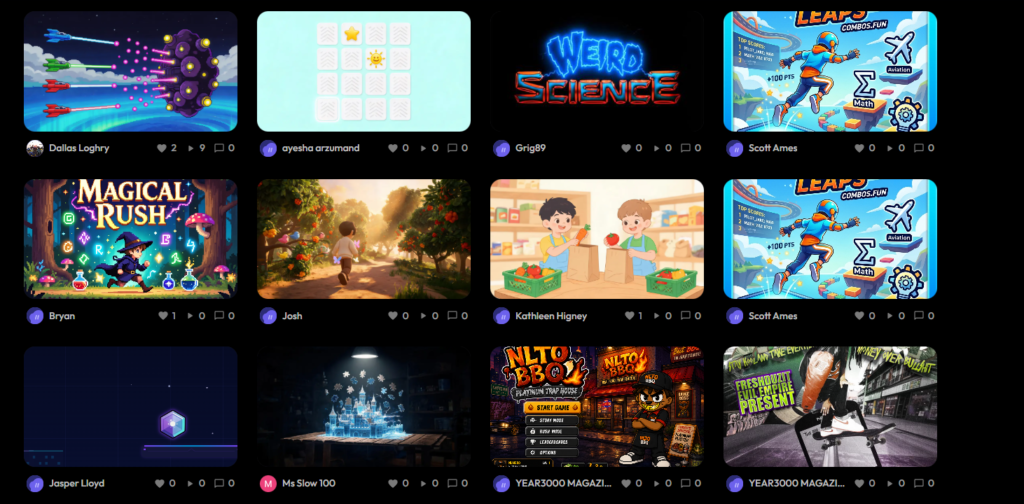
Combos stands out for vibe coding game creation for several reasons that go beyond general capability. The Boo AI game agent inside Combos was designed specifically to handle emotional and aesthetic intent — not just as an edge case, but as a primary use pattern. The pre-communication stage that Boo runs before building anything is structured to preserve the emotional core of the creator’s description rather than to systematise it away into mechanical specifications.
The no-code editor that follows generation is expressive enough to support the kind of aesthetic fine-tuning that vibe coding games require — adjusting colour saturation, movement pacing, ambient audio levels, and environmental density — without requiring any technical knowledge. And the shareable link that Combos produces allows the creator to test the emotional impact of their game on real people immediately after publishing, without any distribution friction.

Tools That Prioritise Aesthetic Control
For creators who come from visual arts backgrounds, the most important criterion for a vibe coding tool is the degree of aesthetic control it provides over the output. Generated assets that cannot be meaningfully adjusted are a creative constraint that undermines the vibe coding approach. If the aesthetic that comes out of the generation process does not match the feeling you were aiming for, the ability to adjust it quickly and intuitively determines whether the tool is usable for serious creative work.
Combos‘ approach to aesthetic control is through natural language direction rather than technical parameter adjustment. Telling Boo “the palette needs to be more desaturated” or “the movement feels too bouncy for this atmosphere” produces adjustments to the relevant parameters without requiring the creator to know which parameters those are. That kind of aesthetic responsiveness is rare and genuinely valuable for vibe coding work.
Speed and Iteration: Which Platforms Keep Up With Creative Flow
Creative flow in a vibe coding game project depends on the iteration speed between the direction given and the result observed. If each adjustment requires waiting several minutes to see the result, the creative momentum breaks. The creator disengages from the emotional core of the project and begins engaging with the logistics of the tool instead.
Combos is fast at both the initial generation stage and the iteration stage. The first prototype arrives quickly enough to preserve the energy of the original prompt. Follow-up adjustments apply and are visible fast enough to maintain creative flow across an editing session. That speed is a practical advantage that compounds — faster iteration means more adjustments per session, which means the final output is more refined and more emotionally coherent.
Pricing That Does Not Punish Experimentation
Vibe coding game creation is an experimental practice by nature. A creator building this way will start many projects for every one they finish — feeling out a mood, generating a prototype, finding that it does not quite land, and moving on to the next idea. A pricing structure that charges per project or per generation actively discourages this exploratory approach by attaching a cost to every experiment that does not pan out.
Combos is free to start, which removes the financial penalty from experimentation entirely. A creator who generates twenty prototypes looking for the one that captures the feeling they are after does not pay twenty times for the search. That freedom to experiment without financial consequence is particularly important for the vibe coding approach, where the path to the right feeling often runs through several attempts.
Conclusion
The best tool for making a vibe coding game in 2026 is one built to interpret emotional intent, provide expressive aesthetic control, iterate quickly, and price in a way that supports experimentation. Combos meets all of these criteria and is specifically designed around the kind of creative workflow that vibe-first game creation demands. If you are approaching game creation from feeling rather than mechanics, Combos is the platform that will keep up with where your creative instincts are going.